Online Therapy in Mandarin Platform Recommendation—FundaTalk: Pricing, Process, Preparation, and Free Resources


For Chinese speakers living abroad — whether in the US, UK, Australia, Singapore, or anywhere in the world — finding a qualified Mandarin-speaking therapist online can feel like searching for something that doesn't quite exist. Most platforms are English-only. Most therapists aren't trained in the cultural nuances that matter to you.
FundaTalk is different. As a Taiwan-based licensed online therapy and counseling platform, we connect Chinese-speaking clients around the world with certified Mandarin-speaking therapists and psychiatrists — people who understand not just the language, but the culture, the family dynamics, and the unspoken pressures that often shape how we carry stress.
This article covers everything you need to know:
- Why FundaTalk is a trusted choice for Mandarin online therapy
- Common questions about online counseling — process, effectiveness, cost, and free resources
- How to get started, even if you're outside Taiwan
Why FundaTalk for Mandarin Online Therapy?
1. Legally Licensed and Fully Compliant
Since Taiwan's Ministry of Health and Welfare officially approved telehealth mental health services in 2019, online therapy has been a regulated, legally recognized service in Taiwan.
FundaTalk is operated by Blossom Medical and holds telehealth and telepsychology licenses issued by the Taipei City Department of Health (License No.: 北市衛中醫字第3501108526號).
Every FundaTalk therapist and psychiatrist has completed certified telemedicine training through Blossom Medical, covering:
- Taiwan telepsychology regulations
- Crisis intervention
- Online group therapy
- Client assessment for telehealth
- Telehealth service procedures
This means when you choose FundaTalk for Mandarin online counseling, you're working with professionals held to the same standards as in-person clinical practice in Taiwan.
2. Taiwan's First Platform Combining Psychiatrists and Psychologists
FundaTalk is operated by the Taipei Blossom Medical team, which includes psychologists and psychiatrists.
We are Taiwan's first dual-track platform combining "psychiatrists + psychologists."
The platform provides a complete referral system, from online therapy and online psychiatric evaluation to in-person clinic treatment, all managed by the Blossom Healthcare team. When necessary, cases can be referred to physical facilities, ensuring medical continuity.
If a user requires medication after an online psychiatric evaluation, the psychiatrist can prescribe medications (excluding controlled substances) in accordance with telehealth regulations. Cases assessed as severe or high-risk will be referred to appropriate facilities. All processes and ethical standards follow those of physical medical institutions.
Case Example:
For instance, if you're unsure whether you're suitable for Transcranial Magnetic Stimulation (rTMS) treatment, you can first consult online for a psychiatrist's evaluation (Related reading: Is TMS effective?). Once treatment is confirmed necessary, you can visit the physical clinic, saving travel time and costs for simple consultations. If the psychiatrist assesses that the severity is low or recommends prioritizing psychological issues, they will refer you to therapy.
3. Exclusive "Session Summary" Feature: See Where Change Begins
After each session, your psychologist or psychiatrist will write a "session summary" based on observations and discussion content, providing you with a personalized written summary and recommendations.
Once the summary is sent, the system will notify you via email. You can respond to your therapist through the built-in one-way messaging function.
All messages use a one-way, single-exchange design—professionals and users each have one opportunity to leave a message. This design considers professional boundaries and user privacy, avoiding blurred therapeutic relationship boundaries.
Related reading: Exclusive New Feature | FundaTalk Introduces "Session Summary": See Where Change Begins
4. Book Your First Session in Under Three Minutes
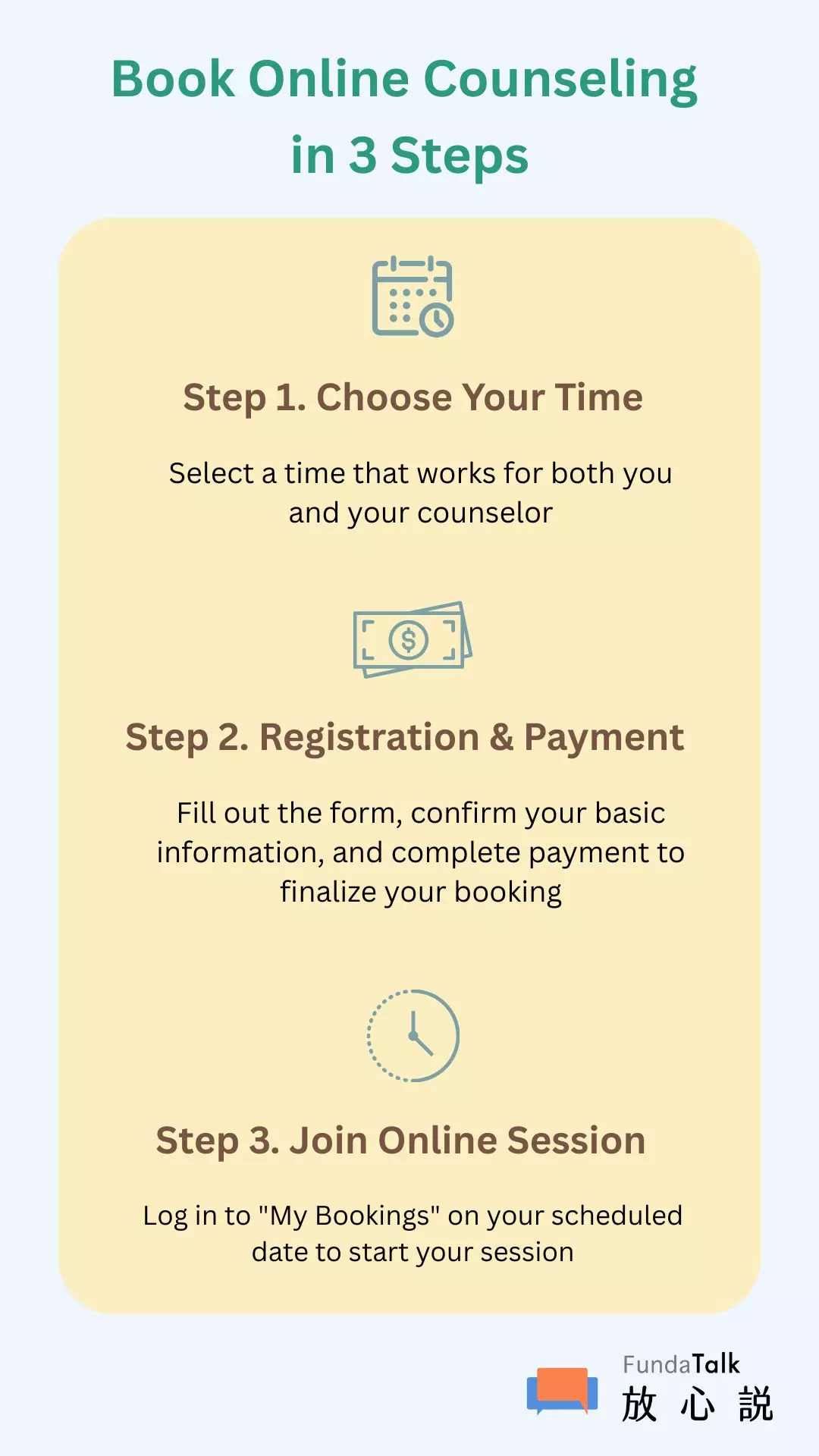
Complicated booking processes create unnecessary friction — especially when you're already carrying emotional weight. FundaTalk's appointment flow is fully digital and takes about three minutes:
- Choose a therapist and time slot that works across time zones
- Complete registration, fill out intake forms, and pay securely by credit card
- Access your session link from "My Appointments" — no manual confirmation needed
Whether you're in Taipei or Toronto, the process is the same.
5. Mandarin and English, Bilingual Throughout
FundaTalk supports both Chinese and English interfaces, and many of our professionals are fluent in both languages. Overseas Chinese clients, Taiwanese expats, and international clients can all book sessions comfortably.
If you're a non-native Mandarin speaker looking for a therapist in Taiwan who can work bilingually, FundaTalk supports that too.
6. Privacy-First Design
FundaTalk uses encrypted video and data protection mechanisms. Each feature is developed through collaboration between professional mental health teams and engineers, ensuring every process meets mental health care needs. You can speak freely in a familiar space with peace of mind.
FundaTalk online therapy is especially suited for:
- Overseas Chinese speakers who need Mandarin-language mental health support
- First-time therapy seekers who feel more comfortable starting online
- People dealing with depression, anxiety, panic disorder, or insomni
- Those navigating relationship issues, burnout, or career transitions
- Adolescents, couples, or families seeking counseling in Mandarin
- Family members of individuals with psychiatric diagnoses
7. Corporate Safety Net: HR-Recommended Employee Assistance Program (EAP)
FundaTalk's EAP program follows the principle of simplification, using a psychological counseling voucher system. Companies don't need IT integration or consume HR hours, and it's suitable for all industries and organizational sizes.
Service Features:
- Flexible payment: Billing based on voucher usage
- Zero approval process: Employees enter vouchers to book appointments—completely confidential
- Service content: Includes psychologist counseling and corporate EAP lectures
- Medical continuity: Can refer to psychiatrists when needed, connecting to physical or online consultations
- Cross-border support: Supports overseas employees and foreign companies
Actual Results:
Companies that implemented FundaTalk EAP services saw a sevenfold increase in mental health resource self-service usage rates in the short term, indicating that employees have always had mental health support needs that previously went unmet due to privacy concerns or complicated booking processes.
Current FundaTalk EAP partners include semiconductor companies and publicly listed enterprises—our experience and professionalism are trustworthy.
8. FundaGPT: AI-Assisted Matching, Available 24/7
FundaGPT is a 24-hour free AI text consultation developed by our professional team. When you're unsure how to choose a professional, you can describe your concerns to FundaGPT. The system will analyze its database and recommend suitable professionals.

Common Questions About Online Therapy
Q1: Is online therapy right for me?
Online therapy is particularly suitable for the following situations:
- Geographic limitations: Living in rural areas with limited mental health resources
- Work schedule factors: Busy work schedule, difficult to match clinic hours
- Privacy considerations: Don't want to be seen by acquaintances at physical clinics
- First-time trying: Unfamiliar with therapy or psychiatric consultation, want to start in a familiar environment
- Difficulty going out: Health conditions, transportation, or other factors make going out difficult
- Overseas needs: Chinese-speaking people living abroad who need Chinese-speaking therapists
Q2: How much does online therapy cost?
Generally, there's no difference between online and in-person therapy fees.
- In-person therapy fee range: Individual in-person sessions (50-60 minutes) cost $2,000-$3,500 NTD
- Online therapy fee range: Individual online sessions (50 minutes) cost $2,000-$4,000 NTD; FundaTalk falls within this range.
Therapy fees generally vary based on the therapist's experience and professional background. If you prefer convenient, immediate, and privacy-focused counseling, check out FundaTalk's online therapist directory.
Q3: Is online therapy really effective?
Research shows equivalent effectiveness to in-person therapy.
While the experience of in-person and online counseling may differ, research published in BMC Psychology journal in 2023 shows that online therapy is equally effective as in-person therapy in improving emotional distress.
The study surveyed college students, comparing groups receiving in-person counseling before the pandemic with those receiving online counseling during the pandemic. Results showed that online counseling was equally effective in reducing psychological distress such as depression and anxiety [1].
If you value privacy or prefer more flexible counseling in terms of time and location, you can confidently choose online therapy that's just as effective and professional as in-person sessions.
Related reading: Is Therapy Really Helpful? Do I Need Counseling?
Q4: How do I choose the right therapist?
On the FundaTalk platform, every therapist is a nationally licensed and certified professional. Their personal pages clearly display:
- Professional license number (verifiable)
- Telehealth certification indicator
- Background and education/experience
- Areas of expertise (such as emotional distress, trauma therapy, career issues, etc.)
- Reviews from users who have completed a session
FundaTalk provides a professional review system that only allows users who have completed a booked session to submit a review. Reviews are displayed under de-identified user IDs, protecting users’ privacy while providing others with practical information to support their decision.
You can filter based on your needs. If you're still unsure how to choose, you can chat with FundaGPT—the system will recommend suitable professionals based on your description. Or contact FundaTalk customer service, and our team will assist you.
Q5: Is there free therapy available?
Currently, the Ministry of Health and Welfare and various city/county governments provide free mental health support resources. Common channels include:
1. Ministry of Health and Welfare "15-45 Age Group Mental Health Support Program":
Subsidizes individuals aged 15-45 facing mental health difficulties, providing 3 free therapy sessions per person during the program period (individual counseling only). Click to search participating institutions.
FundaTalk's physical facilities—Blossom Clinic of Psychosomatic Medicine and Promise Clinic for Child & Adolescent Health—both support this program, but appointment slots are limited. We recommend calling the clinics directly.
Blossom Clinic:
- Phone: 02-2506-9169
- Address: 2F, No. 282, Fuxing N. Rd., Zhongshan District, Taipei City (Google Maps)
- LINE ID: @096jkbbo
- Website: https://www.blossomclinic.com.tw/english-service/
Blossom Promise Clinic:
- Phone: 02-2703-0082
- Address: 8F-1, No. 341, Sec. 4, Xinyi Rd., Da'an District, Taipei City (Google Maps)
- LINE ID: @562sdexi
- Website: https://www.promise-clinic.com/en-us/
Reminder: Some institutions may charge registration or administrative fees. Please confirm the actual total amount before booking.
2. County/City Health Bureaus/Health Centers:
Most local governments provide free or low-cost therapy with annual limits (such as 3-4 sessions). For example, Taichung City provides residents with 4 free consultations in 2025 (appointment and ID required). We recommend contacting your local health authority for the latest programs. For details, see the Ministry of Health and Welfare's list of community mental health counseling services by county/city.
3. 24-Hour Emergency Support Hotlines:
- 1925 Peace of Mind Hotline: 24-hour free service
- 1995 Lifeline: 24-hour service, free from landlines, public phones, and Chunghwa Telecom numbers
Q6: What are common counseling topics?
In fact, counseling topics are unlimited. As long as you feel something is weighing on your heart and you can't find a solution for a long time—that feeling of being "stuck"—you can try counseling.
Common counseling topics:
- Career planning: Job burnout, work promotion decisions, work-life imbalance
- Intimate relationships: Partner communication issues, value conflicts, trust crises, self-identity in relationships
- Stress management: Overly concerned about others' opinions, difficulty adapting to major life changes
- Insomnia troubles: Long-term stress-induced insomnia affecting daily life and work performance
- Depression/Anxiety: Persistent low mood, lack of goals, anxiety about self-worth and existence
Everyone has thoughts they find hard to express but long to be understood. So whether it's career, interpersonal, or workplace difficulties, you can work with a therapist to organize your thoughts and find answers that work for you.
Q7: How often should I have online therapy sessions?
Recommended frequency: Generally, therapy is recommended once a week, about 50 minutes per session—this is the frequency that maximizes therapeutic effectiveness. Most people experience initial adjustment after 6-10 sessions, such as:
- New insights into recurring worries
- No longer blaming themselves for everything
- Ability to pause and recognize feelings when emotions arise
However, cases with deeper issues may require months or even longer to achieve these effects.
Reminder: Everyone's issues and mental health difficulties are different, so we recommend discussing the exact counseling frequency and number of sessions with your therapist.
Q8: What's the online therapy process? What should I prepare?
Pre-Counseling Preparation:
- Find a quiet, undisturbed place: Counseling requires a private, safe space where you can freely express feelings and thoughts without external interference.
- Confirm equipment and stable internet: Online counseling relies on good internet and equipment. We recommend testing your connection beforehand and familiarizing yourself with the platform.
- Organize your mood and state: Ask yourself: What stress or troubles have you encountered recently? Have your emotions fluctuated? What's the source of stress? These are all important elements of counseling.
- Think about your expectations: What goals do you hope to achieve through counseling? Is once a week or once every two weeks more suitable for you? This helps your therapist plan the most appropriate counseling frequency and direction together with you.
Q9: What will we talk about in counseling?
Your therapist will invite you to talk about your recent life, feelings, and experiences. These conversations use open-ended questions to help you understand yourself—they're not casual chat:
- Clarify sources of stress, focusing on key events currently affecting you: What's been troubling you lately?
- Help you identify emotions, understanding the connection between feelings and events: How do you feel about this situation?
- Explore your values and interpretations, guiding you to see thinking patterns and potentially overlooked perspectives: Looking back on this event, how would you interpret what happened?
Being able to understand your own emotions and reactions is the starting point for change and growth.
Therapy won't immediately solve problems, but it can help you gradually understand "who I am" and "what's wrong with me," and find your own way to respond to life's challenges.
Q10: What can I do after counseling?
The effects of therapy don't end in the session—the time afterward is when self-dialogue begins. After counseling, you can try: Process emotions → Try journaling → Share thoughts with your therapist
- Leave time for yourself to let emotions settle: After talking, you might feel a bit relieved or more confused—both are normal. We recommend finding an undisturbed space and sitting quietly for 10-20 minutes, giving yourself space to absorb the conversation and feelings.
- Try journaling: Write down what you talked about and how you reacted. You can also observe: In what situations recently have your feelings been particularly intense? How do you view these emotions? This process is like rewatching a movie—different feelings will emerge, and you'll get to know yourself better.
- In your next session, bring your observations: What did you discover during this time? What made you feel stuck? What moment made you feel different? These are all important clues in the counseling process that can help your therapist work with you to find more suitable ways to understand what you're experiencing in life.
FundaTalk Online Therapy: Making Mental Health Part of Daily Life
As a legally certified online therapy platform, FundaTalk combines dual-track care with psychiatrists and psychologists, comprehensive physical and online referral mechanisms, exclusive session summary features, streamlined appointment processes, bilingual Chinese-English services, and rigorous privacy protection mechanisms to provide users with the most complete mental health support.
Whether you're trying online therapy for the first time, facing depression or anxiety, dealing with interpersonal relationship issues, or your company is looking for an employee assistance program, FundaTalk can provide professional, flexible, and trustworthy services.
References
Sriati, A., Kurniawan, K., Senjaya, S., Khoirunnisa, K., Muslim, R. N. I., Putri, A. M., Aghnia, N., & Fitriani, N. (2023). The effectiveness of digital-based psychotherapy in overcoming psychological problems in college students during the COVID-19 pandemic: A scoping review. Journal of Holistic Nursing, 1–14. https://doi.org/10.1177/08980101231162990
More Articles
 )
) )
) )
)