How Your Family Shapes Who You Are:Without It Being Your Fault or Theirs

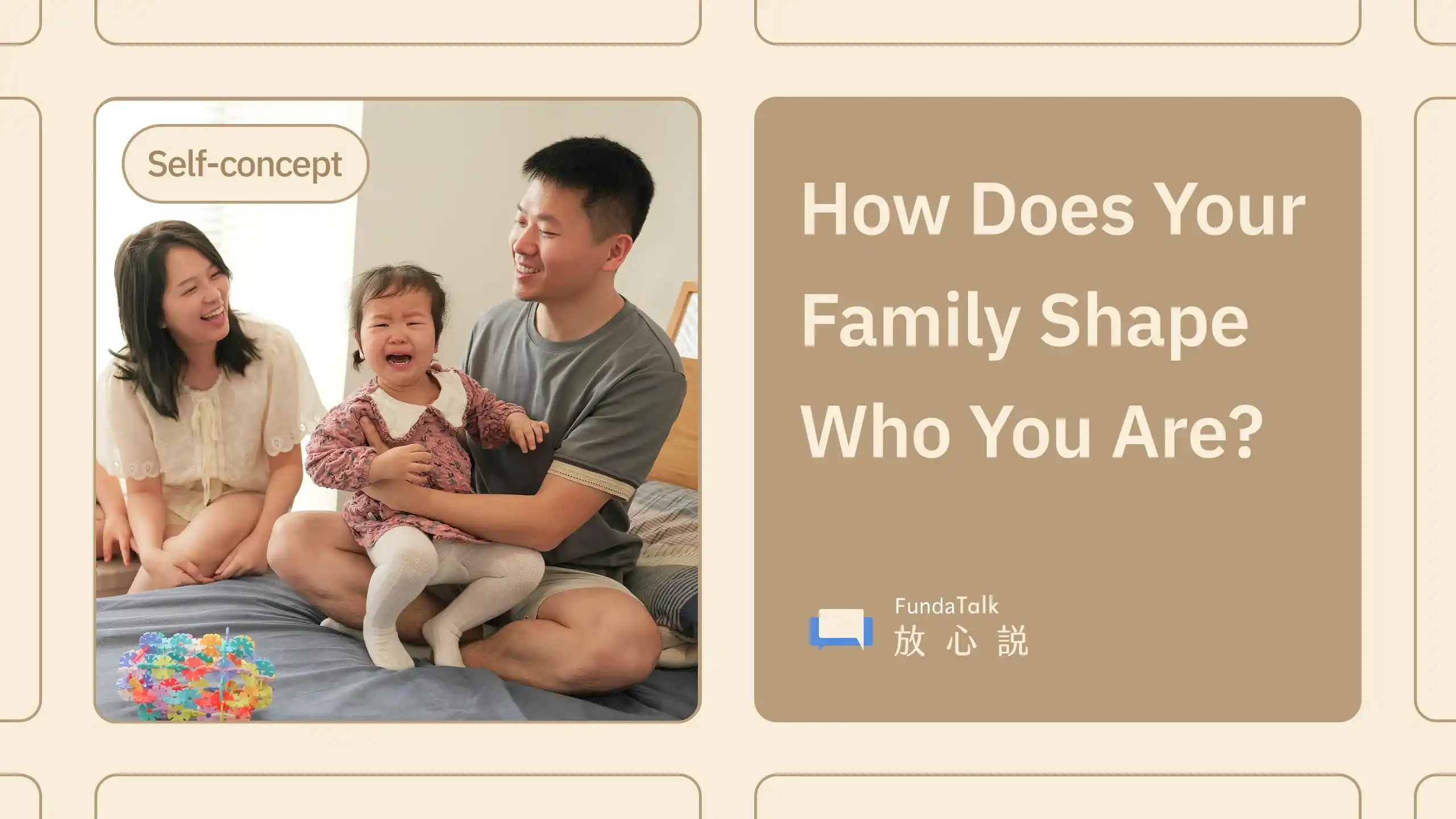
Some people hit thirty and still panic at the thought of disappointing their parents. Some can't stop people-pleasing in romantic relationships. Others are genuinely good at their jobs but deep down believe they're just not good enough.
We tend to write these things off as personality, habit, or bad luck. But once you start learning about family of origin, something clicks. Those patterns that keep showing up in your relationships, your emotional reactions, even the way you talk to yourself, they all tend to trace back to the same place.
That said, talking about where you came from isn't about blaming your parents. It's about understanding yourself. Understanding something doesn't mean excusing the harm it caused, and it doesn't cancel out the love either.
What matters is getting to a place where you can see: every behavior you have made sense at some point, for some reason.

Your Family Wasn't Just Your Childhood. It Was Construction Work on Your Brain.
Psychologists generally agree that personality doesn't come purely from genetics or purely from environment. It's the long-term interaction between the two. And the first few years of life are especially significant, because the brain is developing at a rapid pace during that window.
Neuroscience research shows that the human brain is highly adaptable, what scientists call neuroplasticity. In early childhood, the brain is building millions of new connections every single day. And those connections aren't random. They're shaped in a big way by how caregivers interact with the child.
When a child regularly feels safe, stable, and responded to, the brain starts learning things like:
"The world is a safe place."
"I deserve to be taken care of."
"When things get hard, I can ask for help."
But when a child grows up in an environment with a lot of criticism, neglect, shame, violence, or emotional coldness, the brain starts building a different kind of operating system:
"I can't trust people."
"It's my fault."
"I have to be perfect to be loved."
The child didn't choose any of this. The brain just adapted to survive.
What We Actually Remember Isn't the Events. It's How They Made Us Feel.
A lot of people describe their childhood like this:
"My parents never hit me."
"We weren't poor or anything."
"They were doing their best."
But in therapy, what actually shapes people isn't the events themselves. It's the emotional experience those events created.
Say a kid falls down. If a parent kneels down and says, "That must have really hurt. I'm here with you," the child learns: my feelings matter to someone.
But if the response is, "Stop crying! What's the big deal?" or "How could you be so clumsy?" what the child actually takes away is: my emotions are not okay.
Over time, that child starts suppressing their feelings. By adulthood, they may not even be able to name what they're feeling in the moment. Psychologists call this emotional socialization.
A large body of research shows that whether parents can accept a child's emotions, not just fix the problem, is one of the strongest predictors of that child's mental health, relationship skills, and ability to manage emotions later in life.
Attachment Is the Blueprint for Every Close Relationship You'll Ever Have.
British psychologist John Bowlby developed what's called Attachment Theory. The basic idea is that the way a child interacts with their primary caregiver gradually shapes an internal working model, a kind of internal rulebook that answers three big questions:
Am I someone who deserves love?
Can other people be trusted?
When I need help, will someone actually show up?
Later, researcher Mary Ainsworth ran a now-famous study called the Strange Situation experiment and found that different attachment styles affect how children handle stress, connect with others, and regulate their emotions. Decades of follow-up research have shown that these patterns carry into adult romantic relationships, marriages, and even parenting.
For example:
People with secure attachment tend to build stable relationships and find it easier to trust their partners.
People with anxious attachment are afraid of being abandoned, so they tend to over-give and constantly look for reassurance that they're loved.
People with avoidant attachment learned early on to handle things alone, so they tend to keep their distance in relationships and feel uncomfortable depending on others.
It's worth noting that attachment style is not your destiny. Research also shows that through stable relationships, therapy, or ongoing self-awareness, these patterns can change.
Every Word Said in That House Might Still Be Playing in Your Head.
As adults, we often think these are our own thoughts. But a lot of the time, they're just things our parents used to say.
"Why can't you ever get anything right?"
"Don't bother other people."
"Just tough it out."
"Grades are everything."
Over time, a parent's voice becomes your own internal voice. Psychologists call this the inner critic.
Neuroimaging research has found that children who experience a lot of shame and criticism show heightened activity in the brain's threat-response areas, like the amygdala, when they face failure. Meanwhile, the prefrontal cortex, the part responsible for rational thinking and emotional regulation, has a harder time stepping in to calm things down.
So some people aren't struggling because they don't try hard enough. It's that their brain learned long ago to interpret every setback as proof that they're worthless.
Your Parents Were Also Their Family's Children.
Understanding your family of origin doesn't mean dumping all the responsibility on your parents. A lot of parents were never really loved well either. The previous generation grew up in scarcity, authoritarian households, or high-pressure social environments. What they learned was hard work, endurance, and sacrifice, not emotional expression.
So they loved their kids the way they knew how.
Some showed love by providing for physical needs.
Some expressed expectations through grades.
Some hid their worry behind criticism.
Some never even knew that a hug could be a form of parenting.
This isn't to say all harm is excusable. The point is just that understanding how someone became who they are is different from letting them off the hook. In the same way, understanding your parents doesn't mean you have to give up your own boundaries.
Healing Isn't About Erasing the Past. It's About Responding to Yourself Differently Now.
A lot of people think healing means forgetting their childhood. It doesn't.
Real healing looks like this: when an old wound gets touched, you start responding to yourself in a different way.
For example:
When you get rejected, you don't automatically conclude that you're worthless.
When you make a mistake, you don't punish yourself in pursuit of perfection.
When emotions come up, you don't rush to shut them down. You let yourself pause and figure out what you actually need.
Recent research consistently points to self-compassion as one of the most important factors in mental health. Researcher Kristin Neff describes self-compassion as having three core parts: being kind to yourself, recognizing that struggle is part of being human, and observing your emotions with awareness without getting completely swept away by them. Studies link self-compassion to lower anxiety, depression, and stress, as well as stronger resilience, better relationships, and greater life satisfaction.
This isn't about letting yourself off the hook. It's about not becoming the person who hurts you when things are already hard.
Your Family Shaped You. It Doesn't Define You.
If your family of origin is a tree, then yes, you grew from it. You carry the nourishment it gave you, and you carry the wounds it left behind. Some branches grew strong. Some were bent by the wind. But trees keep growing, and so do people.
Psychologist Boris Cyrulnik spent years studying trauma and resilience. His conclusion: humans are remarkably capable of bouncing back. Even if childhood was full of hardship, encountering even one stable, safe, and supportive relationship at some point in life, whether that's a partner, a friend, a teacher, a therapist, or even one honest conversation where you feel truly understood, can become a turning point for healing.
So instead of asking, "Why didn't my parents give me that?" maybe the better question to sit with is:
What can I give myself now?
When you learn to recognize your emotions instead of denying them, set boundaries instead of constantly giving in, and treat yourself with kindness when you mess up instead of tearing yourself apart, you're actually reshaping your inner world.
The influence of your family of origin is real. It can be deep, lasting, and felt across decades. But modern psychology and neuroscience also tell us that the brain can change, attachment patterns can be repaired, emotional regulation is a skill that can be learned, and a sense of self-worth can be rebuilt.
We can't go back to childhood and rewrite the story for our younger selves. But we can show up today as the adult who is willing to understand, accept, and stay with ourselves.
Maybe maturity isn't about reaching a point where your family no longer affects you at all. Maybe it's about being able to say, gently, when those familiar old wounds start aching again:
"I know how hard it's been for you. Thank you for making it this far. From here on, I've got you."
Those words can't erase the past. But they can be the start of something new. Real healing isn't cutting yourself off from what happened. It's moving forward with understanding. It's not pretending the scars aren't there. It's making sure the scars don't get to run the show anymore. When we're willing to look at ourselves with empathy and awareness, we might just find that our family of origin is the first chapter of our story, but it was never meant to be the last.
Author: Psychologist Zeng Yang Yuan

Further Reading
Your Relationship as a Couple Is the Foundation of Your Child's Emotional World
Talking About Your Family of Origin: How to Recognize Your Attachment Style and Heal Childhood Wounds
Why Are We Never Happy With How We Look? Understanding Appearance Anxiety
More Articles
 )
) )
) )
)