3 signs of burnout at work


Do you frequently suffer from the sunday scaries and dread going to work?
Even on days off, no matter how much you rest, you still feel exhausted. Every weekday morning, you open your eyes and immediately feel anxious, even questioning the meaning of your work?
If you're experiencing the above, you may be dealing with burnout, a condition characterized by prolonged exposure to high-pressure, high-energy-demanding situations without adequate support or recovery time.
Beyond workplace professionals, long-term caregivers, full-time parents, and even students facing continuous academic pressure can all experience burnout.
This article will cover:
- What is burnout?
- Who can experience burnout?
- How to tell if you’re burned out: Burnout symptom assessment
- Why does burnout happen? 3 key reasons
- How to prevent and treat burnout

What Is Burnout?
Definition of Burnout
According to the World Health Organization (WHO), burnout is a health condition resulting from chronic workplace stress that has not been successfully managed. Its core characteristics include:
Emotional Exhaustion: Feeling extremely tired even after adequate rest.
Depersonalization: Feeling indifferent or even disgusted toward work content, colleagues, and people around you.
Diminished Personal Accomplishment: Feeling your work has no value and doubting your own abilities.
How Common Is Burnout?
According to the 2023 Asia Mental Health Index Report by Aon & TELUS Health, employee mental health indices across Asia continue to decline. Taiwan’s burnout problem is particularly severe, with overall mental health scores lagging 11 points behind the global average. Among respondents, 56% reported feeling extremely exhausted, showing that workplace stress has become a critical factor affecting health.
Who Can Experience Burnout?
When we search for “burnout 中文” (burnout in Chinese), we often see the translation “職業倦怠” (occupational burnout), which can mislead people into thinking only office workers experience burnout.
In reality, burnout is fundamentally an imbalance where long-term depletion exceeds recovery.
Common burnout groups include:
- Family caregivers of disabled relatives
- New parents caring for infants day and night
- Entrepreneurs and company executives
- Students facing academic pressure
- Social movement advocates
Anyone in high-pressure, high-output environments without adequate support and rest can experience burnout symptoms.
Do I Have Burnout? Burnout Symptom Assessment
Many people think “not wanting to go to work” is just laziness, but there’s actually a significant difference between burnout and general fatigue.
General fatigue: Recovers after a few days of rest or extra sleep.
Burnout/Occupational burnout: Usually a long-term state of physical and mental imbalance. Key features include compromised physical function (frequent illness, decreased immunity), reduced emotional regulation ability (emotional numbness, inability to feel happiness), and changes in daily behavioral patterns.
Use the following checklist to see which category your condition falls into:
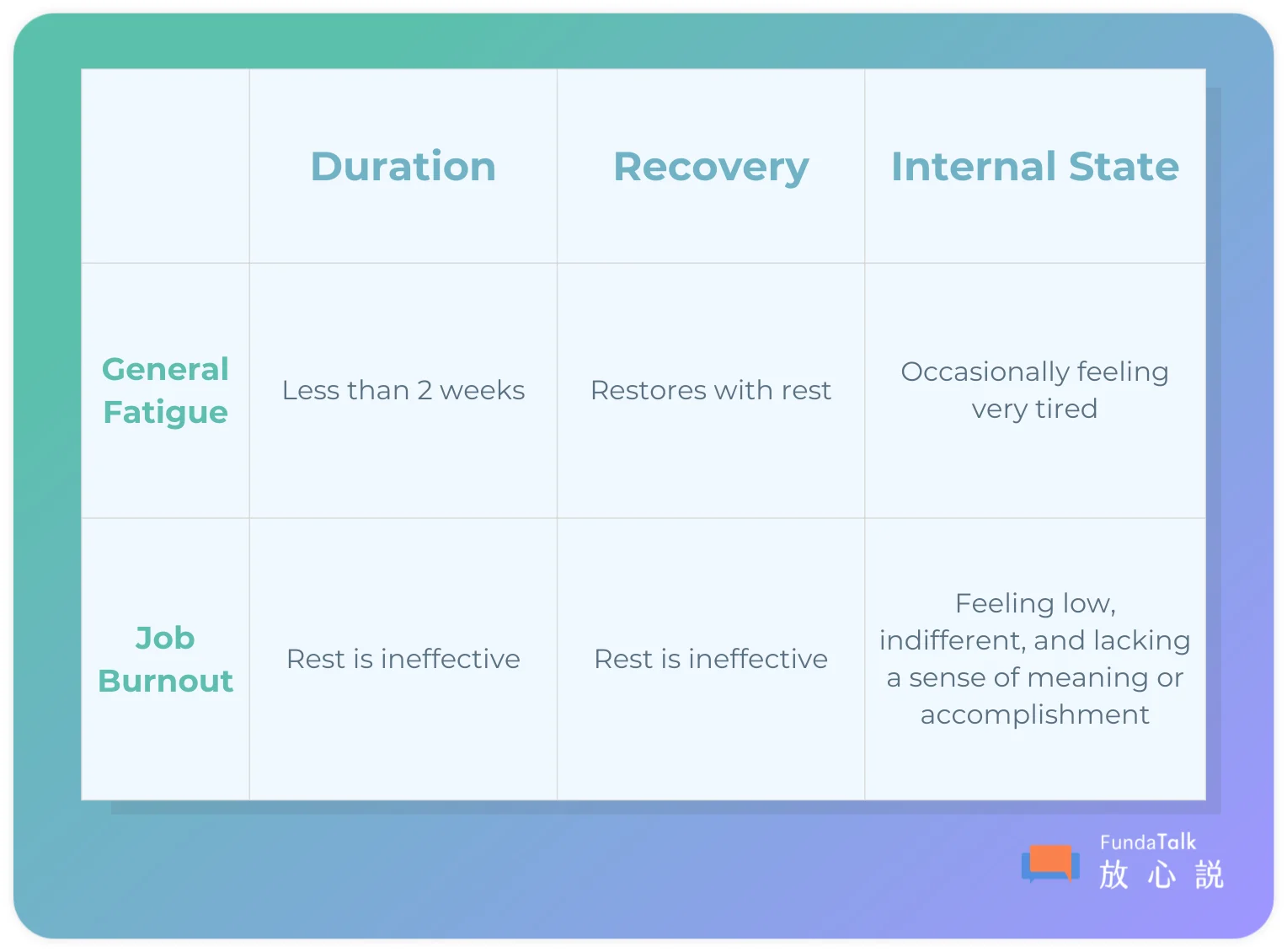
Note: Burnout and depression share many overlapping symptoms, which can make it difficult to tell them apart. If you find yourself consistently experiencing burnout symptoms over an extended period, your body and mind are sending warning signals. Resting alone may not be enough, and more comprehensive adjustments or professional support is recommended.
What Other Common Symptoms Does Burnout Include?
Building on the above, we'll further examine burnout symptoms from three lenses: physical responses, psychological changes, and behavioral abnormalities. This will help you comprehensively understand and identify burnout early for timely intervention.
1. Physical Warning Signs (Your Body Is Protesting)
Long-term overload can trigger chronic fatigue, decreased immunity, and other physical responses, such as:
Never feeling rested: Continuing to feel exhausted despite adequate sleep.
Recurring physical discomfort: Headaches, muscle stiffness, gastrointestinal problems, or frequent colds.
Abnormal appetite: Binge eating or loss of appetite, possibly accompanied by drastic weight changes.
Research shows that ignoring these signals and relying only on caffeine, painkillers, or massage for temporary relief will actually intensify the vicious cycle.
2. Psychological Warning Signs (Your Emotions Are Collapsing)
Burnout affects not only the body but also breaks down psychological defenses. Common manifestations include:
Loss of emotional control: Irritability and agitation set in, and minor issues that were once tolerable become unbearable.
Loss of motivation: Losing enthusiasm for work, decreased concentration, even doubting self-worth.
Crisis of meaning: Repeatedly thinking “What’s the point of doing all this?” and having thoughts of quitting, even questioning life’s broader meaning.
If left unaddressed, burnout can evolve into chronic anxiety or depressive tendencies, further affecting quality of life.
Extended reading: Why Can’t I Feel Happy Anymore? Understanding “Loss of Joy” from a Psychiatrist’s Perspective
3. Behavioral Warning Signs (Your Habits Are Changing)
Additionally, burnout manifests in gradually changing behavioral patterns that we often overlook, such as:
Avoidance tendencies: Increased tardiness, sick leave frequency, refusing social interaction after work.
Substance dependence: Relying on coffee or sweets for energy, or using alcohol to relieve stress.
Passive coping (Quiet quitting): Only completing minimum work requirements without investing extra effort in your duties. This phenomenon of quiet quitting is a major behavioral sign that you are protecting your remaining energy from severe burnout.
These seemingly effective short-term coping strategies can actually deepen burnout feelings, forming a vicious cycle.

Why Does Burnout Happen? 3 Key Reasons
Burnout doesn't happen instantly; it's the result of accumulated long-term stress. Research shows burnout stems from the interaction between individual and environmental factors, including these three major contributors:
External Factors: Navigating a Toxic Work Environment
Occupational burnout often stems from a toxic work environment driven by unreasonable structural stress. When organizational systems chronically ignore employee physical and mental needs, three typical stressors may emerge:
Overload occupations: High working hours, low reward models leading to chronic physical and mental exhaustion.
Conflicting demands: Conflicting or constantly changing requirements from supervisors or clients causing decision fatigue.
Achievement deficiency: Working hard without recognition, remote promotion prospects, undermining intrinsic motivation.
Internal Individual Factors: Traits That Intensify Burnout
Under the same stressful environment, certain traits act like magnifying glasses, increasing burnout risk. Research identifies two internal factors requiring particular vigilance:
Perfectionist tendencies: Excessive self-demands intensifying stress perception.
Neurobiological factors: Trauma or chronic stress weakens the dopamine system, reducing stress resilience and increasing burnout likelihood.
Amplifying Effects of Chinese Culture
Chinese cultural influence is pervasive, with certain cultural values potentially increasing burnout risk:
Diligence tied to self-worth: The mindset that “hardship builds character” normalizes overwork.
Social expectation constraints: Insistence on stable careers prevents burned-out individuals from changing paths.
Stigmatization of emotional expression: Mental health issues viewed as weakness, delaying critical treatment.
These factors cause workers to continue working, not resting, and not seeking help even when experiencing burnout symptoms. In fact, burnout isn’t just a work problem but an imbalance between environmental demands and personal resources. When environmental demands exceed personal resources, occupational burnout occurs.
How to Recover from Burnout? Psychologists Teach You What to Do
If you find yourself on the edge of burnout or breakdown, remember: burnout won’t disappear on its own. You must take action to decompress your brain and body!
Fortunately, our brains have self-regulation mechanisms. Based on neuroplasticity, we can learn and train to cope with stress and build resilience.
Here are several approaches to help regulate your brain, reduce work burnout’s harm, and even gradually overcome it:
1. Brain-Friendly Work Methods: Draw Boundaries, Increase Efficiency
Set clear work hours: Stop working at your designated “off time”, letting your brain know when to “stop running”.
Schedule focused time: Analyze and reduce distractions, allowing your brain to concentrate on high-efficiency tasks.
Try self-management models: Such as SMART: Set Specific, Measurable, Achievable, Relevant, and Time-bound goals, transforming stress from vague uncertainty into a visible, step-by-step plan, letting your brain know what to do next.
2. Rebuild Healthy Habits
Regular exercise: If possible, exercise 3 times weekly—exercise is like a brain spa. If regular aerobic exercise isn’t feasible, even simple walking is effective!
Adjust diet: Reduce caffeine and high-sugar intake, supplement with quality protein and Omega-3s to provide your brain with stress-fighting nutrition.
Regular sleep: Allow your brain to self-repair regularly, maintaining optimal functioning.

3. Find Emotional Outlets, Avoid Internal Exhaustion
Use emotional management techniques: Find a quiet place and imagine dumping negative emotions into a trash can, helping your brain clear emotional noise.
Practice mindfulness: Spend 10 minutes daily focusing on breathing and the present moment, letting your brain pause from stress and restore calm.
Find hobbies: If you don’t have enjoyable hobbies, start cultivating one now! Hobbies replenish passion, focus, and accomplishment. They’re like emotional “health supplements,” keeping us energized.
Maintain interpersonal connections: Talk with supportive friends or family members.
Try psychological counseling: Don’t have adequate support nearby? No problem—professional help can be a good choice: helping you clarify workplace stress issues and find coping strategies.
If These Methods Don’t Work, What Should You Do?
If you’ve tried the above methods but burnout persists, perhaps consider career transition or adjustment. Before resigning, ask yourself these three questions:
Can this job still change?
Can you negotiate adjusted hours, position, or salary?
Does the problem come from the environment or self-expectations?
Will changing jobs really solve the problem? Or will you just change locations while the problem persists? If the core issue is self-worth or career positioning uncertainty, counseling can help you explore deeper career motivations, avoiding the vicious cycle of occupational burnout.
If you find adjustment impossible regardless of efforts, perhaps it’s time to bravely move forward. With professional counseling assistance, you can make decisions more confidently, finding a work environment truly suitable for you.
You deserve a workplace that allows healthy growth. If you’re already feeling burned out, now is the best time to adjust!
Extended Reading
Do I Have Brain Fatigue? Common Symptoms and Self-Assessment Methods
Do I Have Depression? Depression Symptoms, Treatment Options, and Clinic Resources
References
- Afek, N., Harmatiuk, D., Gawłowska, M., Ferreira, J. M. A., Golonka, K., Tukaiev, S., Popov, A., & Marek, T. (2025). Functional connectivity in burnout syndrome: a resting-state EEG study. Frontiers in Human Neuroscience, 19. https://doi.org/10.3389/fnhum.2025.1481760
- Li, Y., Jia, H., Wei, X., Zhen, S., He, S.-C., & Zhang, X. Y. (2024). Interaction of childhood trauma with BDNF and FKBP5 gene polymorphisms in predicting burnout in general occupational groups. European Archives of Psychiatry and Clinical Neuroscience. https://doi.org/10.1007/s00406-024-01825-9
- Maslach, C., Schaufeli, W. B., & Leiter, M. P. (2001). Job Burnout. Annual Review of Psychology, 52(1), 397–422. https://doi.org/10.1146/annurev.psych.52.1.397
- TELUS Health, & Aon. (2023). Asia Mental Health Index Report. https://www.aon.com/getmedia/c36a31bd-273e-446f-b0f5-6944a038f128/Aon-and-TELUS-Health-Asia-Mental-Health-Index-Report-2023.pdf
- Watson, T. (2025). How chronic stress warps decision-making. Nature. https://doi.org/10.1038/d41586-025-00502-8
- World Health Organization. (2024). Burn-out an occupational phenomenon. https://www.who.int/standards/classifications/frequently-asked-questions/burn-out-an-occupational-phenomenon
- Wu, J.-L., Li, Z.-M., Chen, H., Chen, W.-J., Hu, N.-Y., Jin, S.-Y., Li, X.-W., Chen, Y.-H., Yang, J.-M., & Gao, T.-M. (2024). Distinct septo-hippocampal cholinergic projections separately mediate stress-induced emotional and cognitive deficits. Science Advances, 10(45). https://doi.org/10.1126/sciadv.ado1508
More Articles
 )
) )
) )
)