Holiday Stress for Married Women: 6 Ways to Handle Family Pressure, Boundaries, and Christmas Anxiety


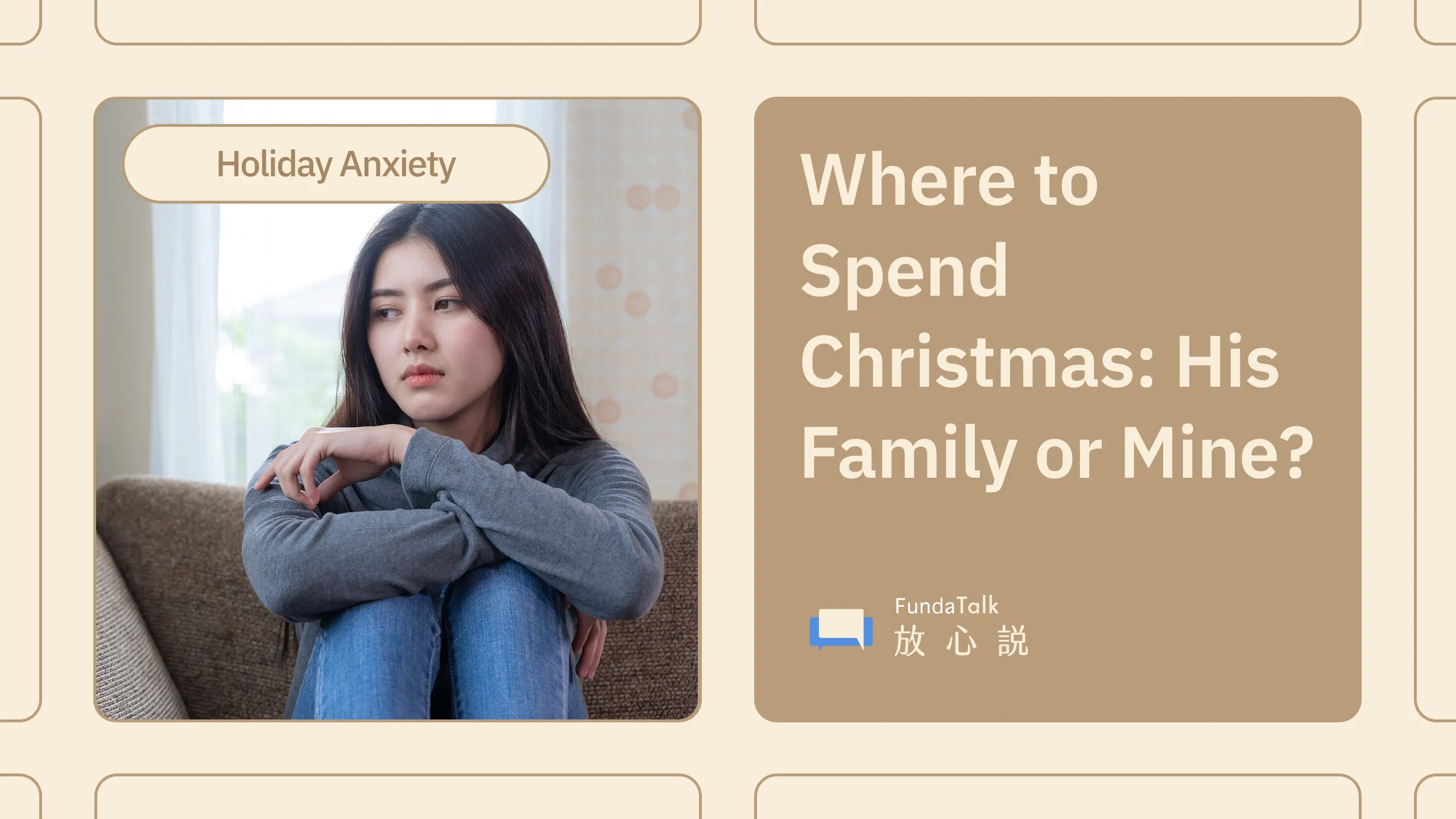
Every Christmas and Thanksgiving, certain conversations tend to come up in therapy sessions: "Whose family do we spend the holidays with?" "How much should we spend on gifts?" "Why do I end up doing all the cooking?" "Am I allowed to feel exhausted when everyone else seems fine?"
Behind these questions are struggles many women face after marriage — around identity, emotional labor, and psychological boundaries, struggles that get louder during the holiday season.
In this article, we've organized 6 common holiday psychological challenges and ways to navigate them:
- Whose family do we spend Christmas with?
- How to handle intrusive questions from relatives
- The pattern of trading labor for acceptance
- What to do when your partner "regresses" at their family home
- How to navigate gift budget stress
- Crowds and holiday noise are wearing you out

1. Whose Family Do We Spend Christmas With?
For many couples, the holidays bring an unspoken tug-of-war: both families have expectations, both partners want to be somewhere that feels like home, and the calendar only has so many days.
Psychological note:
The reason this feels so loaded is that after marriage, you carry two family identities simultaneously — the family you grew up in, and the family you married into. Both are real. Both matter. The conflict isn't a sign that something is wrong with you or your marriage. It's simply what happens when two people with separate histories try to build a shared life.
One reframe worth considering: the home you've built together as a couple is its own unit. Holiday traditions don't have to be inherited — they can be designed.
Practical options:
- Alternate years: one family this Christmas, the other next year
- Split the days: Christmas Eve with one family, Christmas Day with the other
- Combine both families: host everyone together, or join one extended family gathering
- Start your own tradition: stay home as a couple or nuclear family, and visit both families separately on nearby dates
There's no objectively correct answer. The goal is to find what actually works for your specific situation.
2. How to Handle Intrusive Questions from Relatives
"So when are you having kids?" "What do you do again — are you still at that company?" "How much do you two make?" These questions can feel jarring, but declining to answer can feel equally awkward.
Psychological note:
For older generations, asking about life milestones was often a way of expressing care — it was how they showed interest in each other's lives. They may genuinely not realize that asking about salary or fertility isn't the only way to connect. Understanding this doesn't mean you have to answer. It just makes it easier to respond without taking the question personally.
Practical options:
Acknowledge the energy behind the question, then redirect. For example, if someone asks when you're having kids, you might say: "Honestly, life has been so full lately — how have things been on your end?" This passes the conversational ball without conflict and often opens up a much better exchange. If someone keeps pressing, a warm but vague response ("We're figuring things out as we go") is a perfectly valid way to protect yourself while keeping the atmosphere light.
3. The Pattern of Trading Labor for Acceptance
You arrive at the holiday gathering and immediately switch into high-alert mode — noticing whose glass is empty, anticipating what needs to be done before being asked, making sure everything runs smoothly. And somewhere underneath all of that is a quiet fear: if I stop doing this, will they still think well of me?
Psychological note:
This pattern often comes from an unconscious belief: "I have to earn my place here." It's worth pausing to examine that assumption. Does your value in this family really depend on how much you contribute over the holidays? And is anyone else holding themselves to the same standard?
There's also a practical consequence worth noting: when you consistently absorb tasks that others could share, people around you gradually stop seeing them as shared responsibilities. That's not a judgment — it's just how patterns solidify over time.
Practical options:
Try pulling back slightly and see what happens. When a task is implicitly assigned to you, it's okay to say: "I'm not sure I'm the best person for this one — should we figure it out together?" Or simply: "I need a few minutes to rest — I'll pick this up after." You may find that what you feared (disapproval, conflict) doesn't actually follow. And in that space, you might get a clearer sense of what you actually want to contribute — and what you'd rather let go.
4. When Your Partner "Regresses" at Their Family Home
You arrive at your partner's family home and find yourself mapping the social terrain — where to sit, whether it's okay to help yourself to the kitchen, how this family moves through their day. Meanwhile, your partner has collapsed on the couch, back in the rhythm of a place they've known their whole life.
Psychological note:
The core of this isn't unfairness — it's the difference between being on familiar ground and being a guest. Your partner knows the unspoken rules of this house. You're still reading them. That quiet effort of decoding a new environment adds up to a real psychological load, even when nothing visibly difficult is happening. Same room. Completely different internal experiences.
Practical options:
Talk before you get there. Something like: "I know you'll naturally relax when we're at your family's place — that makes sense. But I'm still getting comfortable there, and sometimes I'll need you to check in with me. Can we figure out a signal?" A specific signal — a particular phrase, a text, a look — gives them something concrete to respond to without turning it into a confrontation in the moment.
5. Gift Budget Stress
Spend too little and you worry it looks thoughtless. Spend beyond your means and you feel it for weeks after. Add in the question of whether you're spending equally across both families, and it gets complicated fast.
Psychological note:
It's worth pausing to ask: what am I actually worried about here? Is it financial pressure? The fear of being compared? The need for approval from people whose opinions feel high-stakes? All of these are real. The anxiety usually isn't about the gifts themselves — it's about what the gifts are standing in for.
Practical options:
Set a total budget with your partner that doesn't require you to compromise your day-to-day financial stability, then commit to it. Tell yourself: "This is what we're genuinely able to give right now, and that's enough." The people worth keeping in your life aren't calculating your worth by the price tag.
6. Crowds and Holiday Noise Are Wearing You Out
The house is full, the music is on, everyone is talking at once — and somewhere inside you, something is quietly shutting down. You don't want to be the person who ruins the atmosphere, but you also can't keep going.
Psychological note:
Noisy, high-stimulation environments are genuinely taxing for certain nervous systems. This isn't introversion versus extroversion — it's simply the reality that people have different thresholds for sensory and social stimulation. Neither version is wrong. Some people feel more alive in a full room; others deplete faster and need quiet to recover. Both are just how people work.
Practical options:
Build in recovery time before you hit the wall. Offer to run an errand, take a short walk, or step outside "to get some air." If it's a recurring situation, it's also worth telling family in advance: "I tend to run out of social energy faster than most — I might need to step away for a bit during the day." Honoring your own limits is what allows you to show up with more quality presence when you are there.
A Note from the Therapist:
“You Are Not Responsible for Managing Everyone Else's Experience.”
We're in an era of intense collision with tradition. Many women are expected to be all-capable like traditional daughters-in-law while being independent like modern women.
In the counseling room, we often observe many women with high-functioning anxiety being considerate of all roles, especially those with eldest daughter identity. However, they also bear many responsibilities that aren't theirs.
Family members' expectations and emotions are their issues—you don't need to be responsible for them. Try taking good care of yourself first. May every reader breathe well and truly enjoy the holiday during the New Year period.
Author: Psychologist Chen Jou-An

Further Reading
What to Do About Chronic Insomnia? Understanding Your Brain Fatigue from a Psychological Perspective
Thinking About Therapy But Don't Know How to Start? A Preparation Guide for Online Therapy
Three Common Responses of Anxious Attachment When Replying to Messages
- What Are the Traits of Female Asperger's Syndrome?
- From Taylor Swift's "Eldest Daughter" to the Book "Eldest Daughter Syndrome": A Psychiatrist's Perspective
More Articles
 )
) )
) )
)