What Is High-Functioning Anxiety? Assessment, Self-Soothing Methods, Medication and Non-Medication Treatments at a Glance


This article will help you understand the core concepts of high-functioning anxiety, common impacts and treatment methods, and explain its differences from general anxiety disorders.

What Is High-Functioning Anxiety?
High-Functioning Anxiety is not a formal diagnostic term but refers to a state where one appears highly efficient and capable on the surface while experiencing long-term anxiety internally.
Psychological Level: Includes constant nervousness, irritability, inability to relax, excessive worry, fear of failure, excessive self-demands, etc. Even with success, satisfaction is difficult to feel.
Physiological Level: May experience heart palpitations, rapid heartbeat, muscle tension, gastrointestinal discomfort, insomnia, or chronic fatigue.
Although everything appears normal on the surface, long-term neglect of these symptoms may burden physical and mental health.
Differences Between High-Functioning Anxiety and General Anxiety Disorder
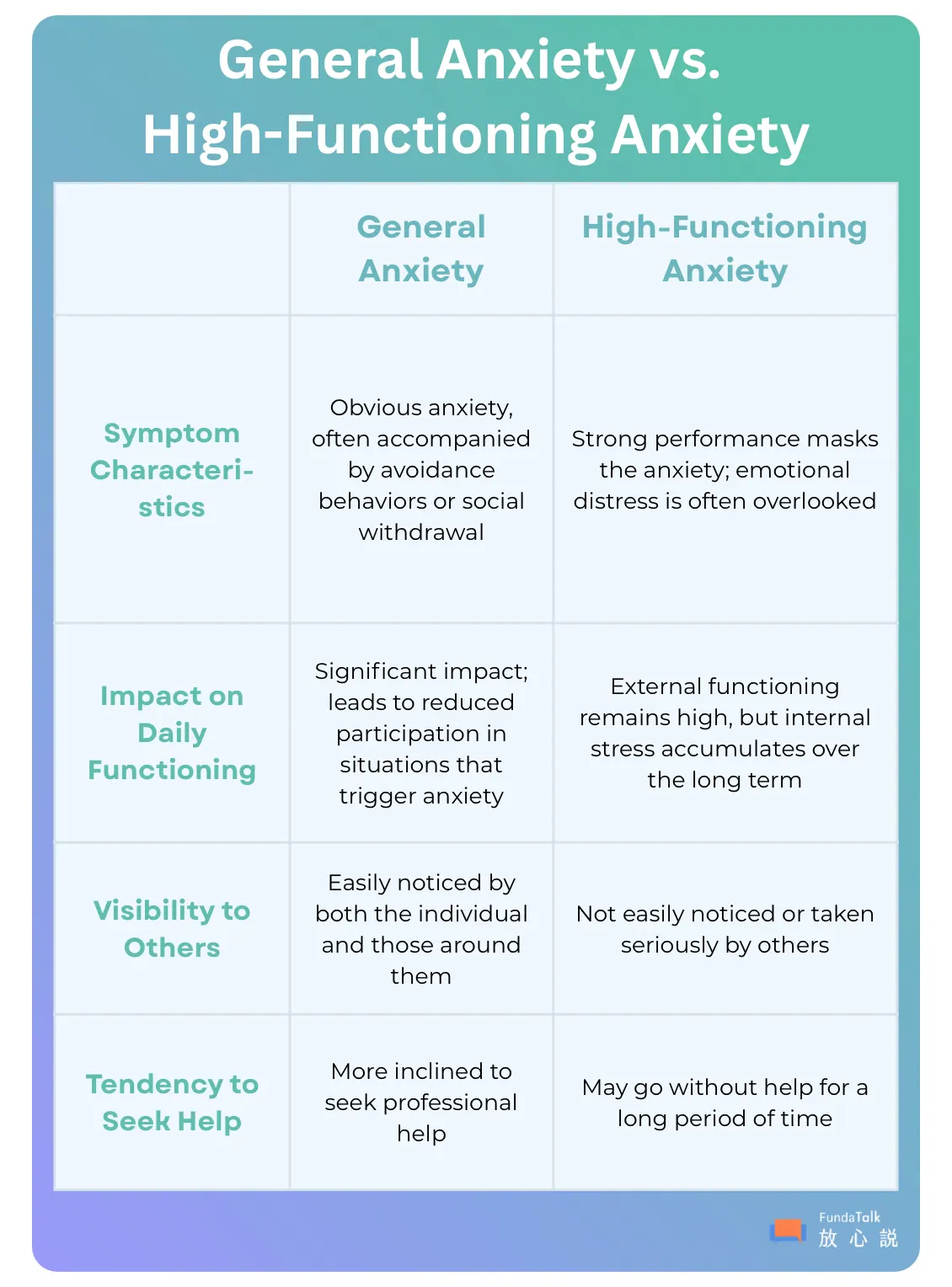
High-functioning anxiety is a special manifestation of anxiety disorder, with important differences from general anxiety disorder:
General Anxiety Disorder Typical Manifestations:
Typical manifestations include obvious anxiety symptoms that affect individuals' daily life functioning, causing difficulties in work, study, or interpersonal relationships.
Individuals may exhibit avoidance behaviors or social withdrawal, reducing contact with anxiety-triggering situations. Additionally, because symptoms are more obvious, individuals and those around them more easily recognize their condition, making it easier to seek professional help.
High-Functioning Anxiety Special Manifestations:
In high-functioning anxiety, anxious emotions actually become motivation driving individuals to pursue higher performance. Individuals not only maintain normal external functioning but often show exceptional performance. However, because symptoms are more concealed, they're often not easily noticed or valued by those around them, leading individuals to potentially bear long-term internal pressure without receiving appropriate help.
General Anxiety Disorder vs. High-Functioning Anxiety
Below is a comparison table of high-functioning anxiety and general anxiety disorder:
Under What Circumstances Should High-Functioning Anxiety Seek Further Professional Help?
High-functioning anxiety may manifest simultaneously in physical, mental, and life aspects. Below are common situations:
Persistent Anxiety: Even when external situations are stable, still long-term feelings of tension, unease, or worry.
Physiological Symptoms: Such as insomnia, chronic fatigue, gastrointestinal discomfort, heart palpitations, muscle tension, etc., affecting daily work and quality of life.
Difficulty Relaxing: Even when physically exhausted, unable to allow oneself to rest, worried that once relaxed, mistakes will occur or be denied by others.
Life Imbalance: Excessive focus on work or responsibilities, neglecting family, friends, or personal interests.
Emotional Management Difficulties: When facing criticism, mistakes, or pressure, experiencing intense self-blame, shame, emotional loss of control, or avoidance behaviors.
Insufficient Self-Care: Long-term sacrifice of sleep, diet, or rest time to maintain external performance.
📌 Reminder: High-functioning anxiety individuals often underestimate their condition or delay seeking help due to good external performance. If the above situations increase in frequency or symptoms affecting life and mental health already appear, discussing promptly with mental health Psychiatrists, psychologists, or counselors can effectively prevent condition deterioration.
Self-Assessment: Do You Also Have High-Functioning Anxiety?
This checklist provides preliminary understanding of your anxiety tendencies, helping you observe thinking and behavioral patterns that may appear in daily life.
High-Functioning Anxiety Self-Assessment Checklist:
Based on your feelings and experiences, determine the frequency each description appears: Often/Sometimes/Rarely/Never.
- Do you often demand perfection from yourself, not tolerating any errors?
- Even when things progress smoothly, do you still frequently worry the future might go wrong?
- Do you habitually start preparing things very early and repeatedly check details?
- Do you often anticipate worst-case scenarios and prepare excessively for them?
- Do you find it difficult to say "no," always taking on excessive responsibilities?
- Do you fear disappointing others, thus ignoring your own needs?
For perfect work performance, do you often work overtime or give up rest? - Do you find it difficult to accept compliments, always feeling you're not good enough?
- Do you often feel muscle tension, headaches, or gastrointestinal discomfort?
- Do you frequently experience insomnia or poor sleep, with your mind constantly thinking?
- Even when resting, do you find it difficult to truly relax?
- Do you worry that once you relax, you'll mess things up or become lazy?
Scoring Instructions:
Scoring Method:
- "Often" = 3 points, "Sometimes" = 2 points, "Rarely" = 1 point, "Never" = 0 points
- Add up scores for all 12 questions, refer to the following range explanations
Score Interpretation:
24 points or above: Highly suspected high-functioning anxiety, strongly recommended to seek professional help
18–23 points: Moderate risk, recommended to consult mental health professionals
12–17 points: Mild risk, recommended to learn stress adjustment and self-care
11 points or below: Currently lower risk, but still need to monitor physical and mental condition and stress management
Usage Instructions and Source
High-Functioning Anxiety is currently not a formal diagnostic name. This checklist is compiled based on clinical experience as a self-observation tool and cannot be used for formal diagnosis. For further evaluation, refer to validated tools like GAD-7 (Generalized Anxiety Disorder Self-Assessment Scale) or BAI (Beck Anxiety Inventory).
Anxiety Disorder Treatment Methods
High-functioning anxiety is not a formal diagnosis but is a type of anxiety, so anxiety disorder treatment methods are listed here. Note that high-functioning anxiety requires integrative treatment because these individuals often have strong self-demands—treatment itself may also become another area where they pursue perfection.
Medication Treatment
Anti-anxiety Medications: Anti-anxiety medications can quickly relieve acute anxiety symptoms, improve sleep quality, stabilize emotions, create good foundations for psychotherapy, and enhance overall treatment effectiveness.
SSRI Antidepressants: SSRI (Selective Serotonin Reuptake Inhibitor) is a common and relatively safe antidepressant that can treat anxiety disorders and prevent relapse by regulating a neurotransmitter called serotonin in the brain.
Non-Medication Treatment
Cognitive Behavioral Therapy (CBT): Mainly helps individuals identify thought patterns causing anxiety, such as excessive worry about failure, fear of not being recognized, etc., and through actual practice, learn to view themselves in more balanced ways.
Biofeedback Therapy: Uses instruments to present physiological signals like heartbeat and muscle contractions in real-time, allowing individuals to directly learn how to relax through visual feedback.
Transcranial Magnetic Stimulation (TMS): TMS is a non-invasive treatment method that achieves brain balance effects by stimulating specific brain regions through magnetic fields.
It's non-radioactive, highly safe, and suitable for individuals with limited medication or psychotherapy effectiveness.
According to a statistical report published by Blossom Clinic of Psychosomatic Medicine in 2025, rTMS (repetitive transcranial magnetic stimulation) response and remission rates for anxiety individuals are typically higher than depression, with faster improvement speeds. After receiving 12 treatments, approximately 39.96% of individuals meet response criteria, 30.80% meet remission criteria. Upon completing 36 treatments, both response and remission rates can reach 53.23% [3].
How to Improve Anxiety? Evidence-Based Soothing Methods
High-functioning anxiety individuals often equate excellent performance with personal value—this thinking makes anxiety and perfectionism an endless pressure.
Actually, we can use some small daily techniques to gradually loosen this equation. Below are two methods:
Anxiety Budget Management Method
Imagine you have an "anxiety wallet" with only 30 minutes quota daily that needs to be used all at once. When anxiety emerges, first tell yourself: "Okay, wait until worry time." During those 30 minutes, focus on thinking about those worries, even writing them down. When time's up, tear up or throw away the paper, making an actual action to give yourself psychological closure.
The key to this method is: anxiety doesn't need to immediately disappear but is "arranged" into a safe, bounded range.
Perfectionism Stress Reduction Technique
Rather than constantly proving yourself through performance, change perspective to remember "who I am." Write down three simple affirmation sentences daily, like:
- I deserve to be loved because I am me
- I can have imperfect moments
- My value isn't only in outcomes
Then select 3-5 core values unrelated to achievement (such as kindness, sincerity, helping others, humor), deliberately doing one small thing weekly to practice them. This reminds yourself: value isn't only in numbers on performance reviews but can be demonstrated in ongoing actions and interpersonal relationships in life.
Conclusion
Although high-functioning anxiety appears normal or even excellent externally, long-term internal anxiety may impact physical and mental health. Effective intervention typically requires integrative treatment, including professional psychotherapy, necessary medication assistance, and daily self-adjustment for anxiety and perfectionism tendencies. Mastering these core strategies not only helps soothe anxiety but also enhances self-identity and life satisfaction, enabling high-functioning anxiety individuals to better balance physical and mental health with self-value establishment while pursuing achievement.
Extended reading: What Are Work Burnout Symptoms? Assessment Table, Common Physical and Mental Warning Signs, What to Do When Burned Out, Three Questions Before Changing Jobs
Extended reading: High School Students Don't Want to Go to School, What to Do? School Refusal Reasons and Accompaniment Methods at a Glance
Reviewed by: Dr. Chia-Yi Yao

Treatment Areas:
Depression, anxiety disorders, panic disorder, bipolar disorder, insomnia, stress management, women's mental health, memory decline, dementia, late-life depression, elderly sleep disorders, rTMS treatment
References
- Mental Health Foundation. (2023). Uncertain times: Anxiety in the UK and how to tackle it (Mental Health Awareness Week 2023 report). https://www.mentalhealth.org.uk/our-work/public-engagement/mental-health-awareness-week/anxiety-report/what-causes-anxiety
- Swain, J., Hancock, K., Hainsworth, C., & Bowman, J. (2013). Acceptance and commitment therapy in the treatment of anxiety: A systematic review. Clinical Psychology Review, 33(8), 965–978. https://doi.org/10.1016/j.cpr.2013.07.002
- 洪敬倫 (2025年1月23日). 數字會說話:振芝沃本 448 位 rTMS 個案療效完整解析. 振芝心身醫學診所. https://www.blossomclinic.com.tw/l/%E6%95%B8%E5%AD%97%E6%9C%83%E8%AA%AA%E8%A9%B1%EF%BC%9A%E6%8C%AF%E8%8A%9D%E6%B2%83%E6%9C%AC-448%E4%BD%8D-rtms-%E5%80%8B%E6%A1%88%E7%99%82%E6%95%88%E5%AE%8C%E6%95%B4%E8%A7%A3%E6%9E%90/
More Articles
 )
) )
) )
)