Why Are We Never Happy With How We Look? What Appearance Anxiety Has to Do With It

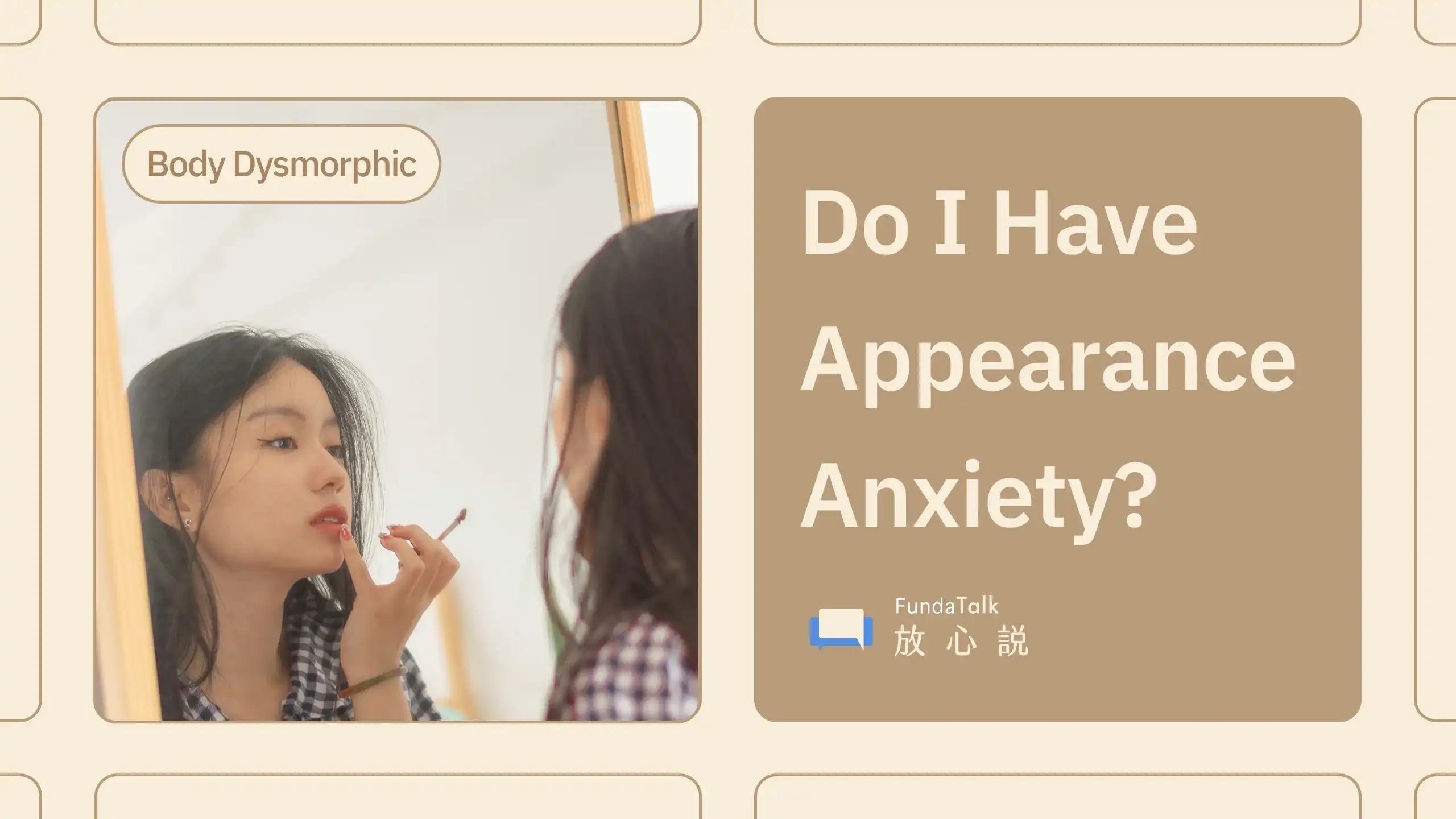
At 20, you might fixate on your nose not being sharp enough, your eyes not being big enough, your skin not being fair enough. By 35, you're noticing how everything has started to sag, when those smile lines got so deep, and why you always look so tired in photos.
The thing you're anxious about may change. But that unease when you look in the mirror never really seems to go away.
This article covers:
- What is appearance anxiety?
- 5 common causes of appearance anxiety
- Appearance Anxiety self-screening tool
- What to do about appearance anxiety: 5 ways to find relief
- Further reading: recommended books on appearance anxiety

What Is Appearance Anxiety?
Appearance anxiety refers to persistent dissatisfaction, lack of confidence, worry, and anxiety about one's own physical appearance.
Is Appearance Anxiety a Mental Health Condition?
When appearance anxiety becomes severe enough, it can meet the criteria for Body Dysmorphic Disorder (BDD), a diagnosis included in the DSM-5. The core feature of BDD is an excessive, repetitive preoccupation with perceived flaws in one's appearance. These "flaws" are typically minor or completely invisible to others, yet feel significant and real to the person experiencing them.
Someone with BDD may magnify perceived imperfections, spend large amounts of time checking or concealing their appearance, repeatedly seek out cosmetic procedures or dermatology consultations, and experience persistent low mood and difficulty maintaining daily functioning because their appearance doesn't meet their own expectations. Classified as a type of obsessive-compulsive disorder, BDD requires professional psychiatric evaluation and intervention.
5 Common Causes of Appearance Anxiety
Appearance anxiety can develop through a combination of social, cultural, and psychological influences. Here are the most common contributing factors.
Social media raises the bar for what "normal" looks like.
When we scroll through social media, we are naturally drawn to images of conventionally attractive people. Algorithms pick up on this and keep feeding us more: carefully curated, filtered, and perfectly lit photos. Over time, our internal standard for what faces and bodies are supposed to look like quietly shifts upward, and we can begin to forget that real people in real life don't look like that all the time.
2. Fear of being judged by others.
As beauty standards rise, the gap between how we actually look and the polished images we see online becomes a source of anxiety. During the pandemic, masks covered half of people's faces and, with them, some of the anxiety around being evaluated. When mask mandates lifted, the direct eye contact and exposure that masks had absorbed came rushing back, and so did the discomfort of feeling seen and assessed by others.
3. A history of being criticized for your appearance.
Being mocked or criticized for how you look, or growing up in an environment where negative comments about bodies were common, can have a lasting impact on how you evaluate your own appearance. It might have been something as offhand as "your nose is kind of big" or "you've put on some weight, maybe you should diet." Regardless of how serious these comments seemed at the time, they can leave marks that run deep.
4. A perfectionist personality.
People with perfectionist tendencies hold themselves to high standards across the board, which means that even small imperfections can feel disproportionately significant. Noticing a minor flaw becomes an invitation for self-criticism, and over time this can erode confidence and create fertile ground for appearance anxiety to develop.
5. Stress from major life transitions.
Changing schools or jobs, entering adolescence or midlife, stepping into a new social circle or a new phase of life: all of these transitions bring varying degrees of stress. When the pace of change exceeds what a person can comfortably absorb, anxiety begins to surface, and appearance anxiety can be triggered or intensified as a result.
Appearance Anxiety Self-Screening Tool
The Appearance Anxiety Inventory (AAI) is a validated psychological scale developed by Veale and colleagues in 2014, designed to assess appearance-related anxiety, particularly in the context of Body Dysmorphic Disorder.
Based on your experience over the past week, indicate how often each of the following applies to you. Use a scale of 0 (Not at all) to 4 (All the time) [2].
Scoring:
This is a self-report scale with a total score range of 0 to 40. Add up your scores across all 10 items to get your total.
Results:
0 to 13: No significant appearance anxiety at this time.
13 to 21: Mild appearance anxiety is present. Talking to someone or seeking professional support may help you feel more confident and at ease in your own skin.
21 and above: Symptoms consistent with Body Dysmorphic Disorder (BDD) may be present. Scheduling an evaluation with a psychiatrist or psychosomatic medicine specialist is recommended.
If your concerns about your appearance are already affecting your daily life, social functioning, or emotional wellbeing, such as frequent cosmetic procedures causing financial or physical harm, or avoiding going out due to low self-confidence about your looks, this level of distress deserves serious attention and may benefit from professional intervention.
Scale results are for reference only and do not constitute a clinical diagnosis.
What to Do About Appearance Anxiety: 5 Ways to Find Relief
Before getting into the strategies, it's worth pausing to sit with a few questions:
Is what you're worried about your appearance itself, or the judgment your appearance might receive?
If you've looked in the mirror three times and the anxiety hasn't eased, what is it that makes you want to look a fourth time?
The core of appearance anxiety isn't simply "I'm worried about how I look." It's closer to: "I'm worried about whether my appearance meets my own standard, and what other people see when they look at me." When we think we're anxious about our looks, what we are often actually anxious about is being judged, criticized, or rejected because of them.
The following approaches are designed to help you create a little more breathing room when that anxiety shows up.
1. Notice the thought beneath the feeling, and ask whether it's a fact or a judgment.
When appearance anxiety surfaces, ask yourself: "What is going through my mind right now?" This shifts your attention from the external to the internal, helping you identify what you are actually afraid of. Once you've identified the thought, ask whether it is a statement of fact or a value judgment. Making this distinction helps you stay grounded in what is objectively true, and reduces how much energy you spend on narratives that are really just self-criticism in disguise.
2. Listen to your body with kindness.
When we are preoccupied with how we look, we often lose sight of something worth appreciating: our bodies make a remarkable amount possible. We use our faces to communicate feeling, our hands to do our work, our legs to take us where we want to go. Turning attention toward what your body helps you do, and acknowledging it with warmth, can begin to build a more positive relationship with it. Even when you want to change something, it's worth asking first: what is driving this desire? What am I hoping this change will bring?
3. Interrupt the checking cycle by tolerating a little more each time.
A therapeutic approach used for compulsive behaviors is called Exposure and Response Prevention (ERP). The core idea is to deliberately refrain from performing the habitual response after encountering an anxiety-provoking situation, to avoid getting trapped in the cycle of "anxiety, check, brief relief, anxiety again, check again." When you feel appearance anxiety rising and want to look in the mirror, try choosing not to, or limiting how many times you allow yourself to check. Over time, you can learn that the outcome you were dreading doesn't actually happen when you hold back. This takes time. Starting with small steps and gradually building tolerance is more sustainable than trying to stop everything at once.
4. Expand your sources of meaning and self-worth beyond appearance.
Being attractive is something people admire, but a person's value is not measured by looks alone. It includes professional capability, how you treat others, the connections you build, and the way you move through the world. When we can hold all of these dimensions alongside appearance, rather than centering appearance above everything else, and when we commit to showing up fully in daily life, we may not be perfect, but we become more complete.
5. Reduce social comparison pressure by curating your digital environment.
If scrolling through social media leaves you feeling worse about how you look, reducing the time you spend on it, or unfollowing accounts that trigger comparison, is a reasonable and practical step. It's genuinely difficult to talk yourself out of comparison by willpower alone. If these images aren't making you feel better, just more anxious, then actively reducing your exposure to that source of stress and redirecting your attention toward content that interests or nourishes you is a real form of self-care.
The strategies above are most suited to mild to moderate appearance anxiety. If you find yourself spending more than an hour a day checking your appearance, experiencing severe anxiety as a result, avoiding important occasions because of how you look, or remaining unsatisfied after multiple cosmetic procedures, seeking professional support will be more effective than continuing to manage it on your own.
Closing Thoughts
Caring about your appearance is a preference. Appearance anxiety is a drain. It has identifiable causes, and it has concrete ways of being addressed. If certain sections of this article felt uncomfortably familiar, that recognition, and whatever you feel in this moment, can be where change begins.
Author: Psychologist Hung Tzu-Hsuan

Further Reading: Recommended Books on Appearance Anxiety
For a more complete look at the psychological mechanisms and cultural context behind appearance anxiety, consider Appearance Anxiety: Breaking Free from the Cycle of Stress, Depression, and Disordered Eating to Rediscover and Love Your True Self by psychologist Wang Yu-Yun. Drawing on 20 real case studies, the book explores appearance anxiety across a wide range of experiences, including body image concerns in adolescents, muscle dysmorphia in men, appearance-based discrimination in the workplace, and body identity struggles among transgender individuals. If you relate strongly to concerns about your appearance, or scored 13 or above on the scale above, this book can serve as a valuable next resource.
Further Reading: Recommended Articles
Generalized Anxiety Disorder: Symptoms, Causes, Types, GAD-7 Test, and Treatment Options
Quiet, Withdrawn, and Angry? How Anxiety Presents Differently in Men
Anorexia Nervosa: Early Warning Signs, Causes, Self-Test, Treatment, and Everything You Need to Know
My Child Refuses to Go to School: Causes of School Refusal in Teens and How to Help
Reference
- Lai, C.-S., Lee, S.-S., Yeh, Y.-C. and Chen, C.-S. (2010), Body Dysmorphic Disorder in Patients With Cosmetic Surgery. The Kaohsiung Journal of Medical Sciences, 26: 478-482. https://doi.org/10.1016/S1607-551X(10)70075-9
- Veale, D., Eshkevari, E., Kanakam, N., Ellison, N., Costa, A., & Werner, T. (2014). The Appearance Anxiety Inventory: Validation of a Process Measure in the Treatment of Body Dysmorphic Disorder. Behavioural and Cognitive Psychotherapy, 42(5), 605-616. https://doi.org/10.1017/S1352465813000556
More Articles
 )
) )
) )
)