Does Therapy Really Work? Do I Need Counseling? Pricing, Free Resources, and Top Online Platforms at a Glance


Introduction
When people first hear about therapy, these questions often flash through their minds: "Do I really need it?" "What am I supposed to say there?" "Does therapy actually work?"
The truth is, therapy isn't just for people who are sick—it's more like a safe space that helps you organize your thoughts and improve your decision-making quality.
In this article, we'll help you understand:
- What is therapy?
- When do you need therapy?
- Does therapy work?
- What should I say in my first therapy session?
- How much does therapy cost per session?
- Free mental health resources
- Top recommended therapy platform: FundaTalk's four key features at a glance

1. What Is Therapy?
Therapy is a process of dialogue with a professionally trained psychologist.
The focus of therapy is seeing the root of problems.
Beyond listening to your concerns, psychologists use professional questioning to help you explore the emotions and beliefs behind behaviors—those "internal patterns you haven't noticed that are actually affecting you".
For example: A student always felt particularly anxious at school and thought it was because he was introverted. But in therapy, he discovered that anxiety was actually related to "fear of disappointing his family".
When he began understanding where his emotions came from, he could make subsequent adjustments accordingly.
2. When Do You Need Therapy?
You don't have to wait until emotions overflow or become unbearable to seek therapy. Its scope is broad—whenever you "need to organize your thoughts" in life, you can consider therapy as a resource.
For example:
Stress and exhaustion: High work pressure, always feeling like you can't breathe.
Anxiety and insomnia: Clearly small matters, yet constantly worrying and sleeping poorly.
Overly high self-expectations: Frequently overthinking and being harsh on yourself.
Tense relationships: Ongoing conflicts with partners (husband or wife), family, children, or friends.
Unable to let go: Knowing you should move on but can't.
The value of therapy lies in organizing how your internal world operates. Beyond processing emotions, it's a process of enhancing self-understanding and decision-making quality.
👉 Want to try online therapy? Check out psychologist profiles on the FundaTalk platform
3. Does Therapy Work?
This may be the most common question people have.
The answer is: yes, but what "works" looks like may not be what you expect.
Therapy won't immediately bring "outcome changes"—it's more about cognitive improvement: therapy helps you see your behaviors or patterns and begin discovering, "I actually have other choices".
During the therapy process, you'll gradually learn to:
- Understand the same situation from different perspectives
- Try new response methods
Better understand yourself and make choices more suited to you accordingly
Behavioral change mostly comes from these subtle but important "thought shifts", and this is precisely therapy's focus: helping you identify the sources and triggers of these patterns, providing possibilities for adjustment.
4. What Should I Say in My First Therapy Session?
During the first session, many people feel nervous: "Should I prepare something?"
Actually, you just need to bring a desire to understand yourself—that's enough.
You can write down what you want to discuss on paper, such as:
Recent troubles: Like friction in getting along with partners, excessive parenting pressure, workplace adaptation difficulties, or feeling life is stagnant and directionless.
Thoughts keeping you awake: Like doubting whether you're competent in your parental role, alienation in marriage, work-life imbalance.
Recurring troubles: Like easy anger, guilt, anxiety, feelings of isolation, or emotional manipulation and unfocused communication in parent-child relationships.
Expectations and concerns about therapy: Worrying about saying the wrong thing, being misunderstood, or having reservations about "therapy's effectiveness".
Even if these thoughts are scattered and incoherent, that's okay. The psychologist will help you organize thoughts, won't force you to say things you don't want to, and won't criticize you. If you can't speak right away, they'll use natural questions to guide you, like: "When are these feelings most obvious recently?" Through such guidance, you can gradually organize your thoughts and better know yourself.
5. How Much Does Therapy Cost Per Session?
In Taiwan, therapy fees typically vary based on region and psychologist experience.
Generally, sessions are 50 to 60 minutes, priced between 1,500 to 4,000 TWD.
At first glance, the cost isn't low, but if you understand therapy as a "psychological consultant for improving cognition and seeing your blind spots", you'll find it's actually a worthwhile health investment.
👉 Browse FundaTalk psychologist profiles with different specialties
6. Are There Free Mental Health Resources?
Government Resources
County and city governments provide free psychological consultation hotline services, open for people to call and make appointments. For usage limits, please refer to regulations published on each county/city website.
The Ministry of Health and Welfare provides national psychological consultation and emergency service hotlines, such as the Peace of Mind Hotline, Lifeline, Teacher Chang, Senior Friend Hotline, Men's Care, Dementia Care, and Family Caregiver Care Hotline.
Corporate or School Programs (EAP)
Some companies and schools have partnered psychologists; employees or students can use these resources based on circumstances:
Students can seek help from their school's counseling center. Counseling center names may differ between schools—for example, National Chengchi University's counseling center is the "Mental and Physical Health Center", while National Yang Ming Chiao Tung University's is the "Healthy Psychology Center".
Corporate employees can check internal company announcements or websites to see if employee therapy assistance programs are provided. (Reference: FundaTalk Corporate Program)
Free Online Mental Health Consultation: FundaGPT
The AI assistant FundaGPT designed by the FundaTalk platform can provide preliminary psychological support based on your concerns, simple mental health assessments, and further recommend suitable Psychiatrists, psychologists, or referrals to appropriate resources.
7. Recommended Online Therapy Platform: FundaTalk's Four Key Features
FundaTalk is a mental health support platform providing video psychiatric consultations and video therapy services. FundaTalk has the following features:
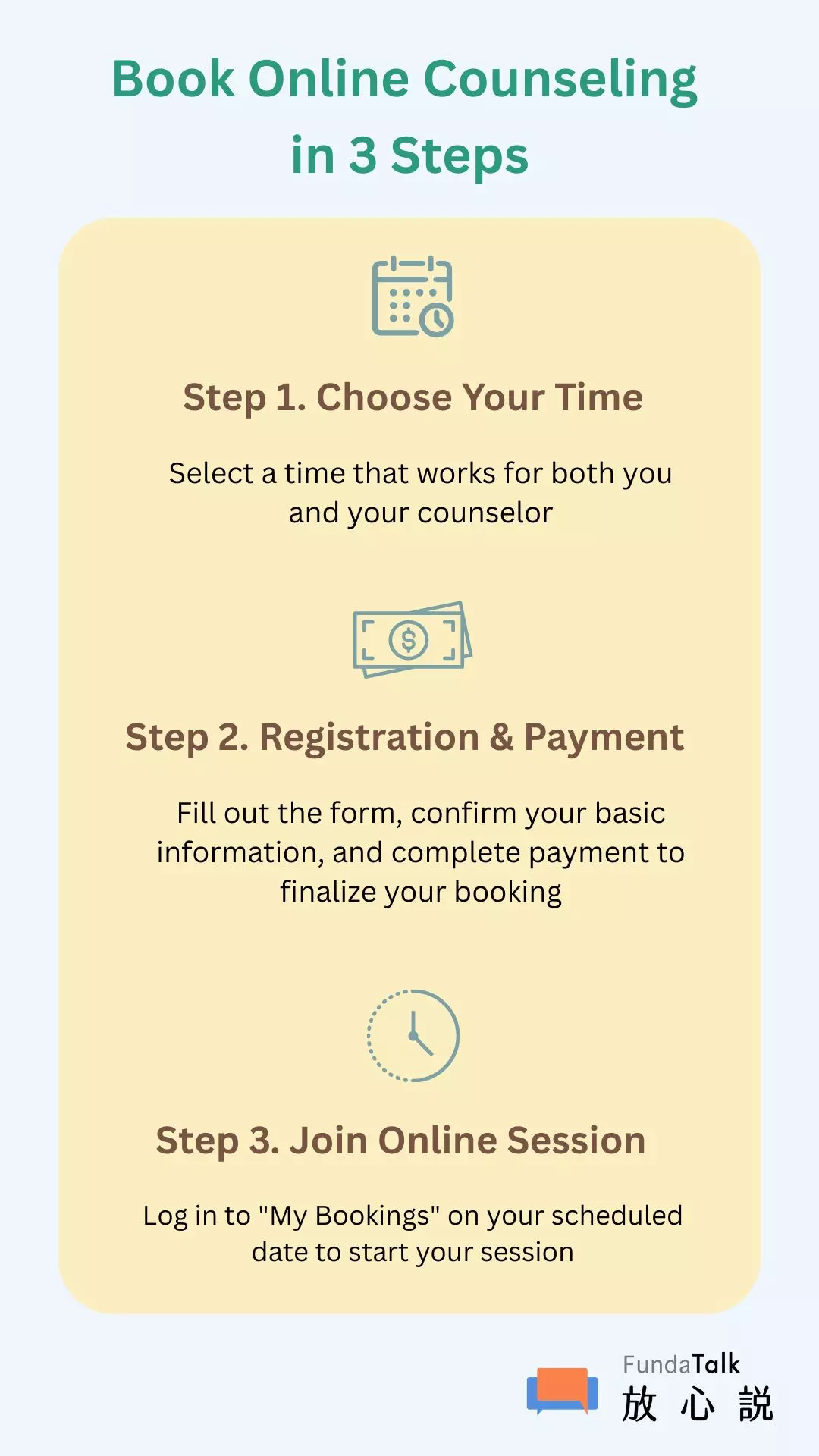
1. Complete Booking in Three Steps
To allow users to conduct online therapy or consultations more efficiently, FundaTalk has simplified the booking process to just three steps:
- Select appropriate professional and time
- Complete registration and payment
After payment completion, you'll receive a confirmation email—booking complete
2. Exclusive Feature: Session Summary
At FundaTalk, psychologists or Psychiatrists provide session summaries after each session, including that day's conversation summary and professional recommendations, allowing users to more clearly see their situation and next steps.
3. Flexible Connection Between Online and In-Person
Beyond online services, FundaTalk has three physical locations in Taipei, each corresponding to different needs: 1. Comprehensive mental and physical assessment integrating neuroscience, 2. Brain stimulation and brain health programs, 3. Child, adolescent, and youth support.
If professionals discover during online sessions that you need further treatment, arrangements can also be made for in-person clinic visits, ensuring every client receives comprehensive treatment and care.
FundaTalk's Taipei Physical Mental Health Locations Include:
Blossom Clinic of Psychosomatic Medicine:
Provides psychiatric outpatient services, in-person therapy, brain assessments like qEEG and autonomic nervous system evaluation, sleep testing, etc.—a psychiatric clinic integrating neuroscience and psychotherapy.
Address: 2F, No. 282, Fuxing N Rd, Zhongshan District, Taipei City
Appointment Hotline: 02-2506-9169
BASIC Clinic for Brain Health:
Focused on brain health, with a professional team holding international clinical TMS certification and training institution status.
Services include standard repetitive transcranial magnetic stimulation (rTMS), Deep TMS, cranial electrotherapy stimulation (CES), transcranial photobiomodulation (tPBM), and brainwave testing, for further treatment of depression, anxiety, obsessive-compulsive disorder, and post-traumatic stress disorder.
If you're currently overseas considering TMS treatment but temporarily unable to visit the clinic in person for evaluation, you can first consult with Psychiatrists online through FundaTalk. Psychiatrists will provide professional advice based on your situation; if suitable after evaluation, they can also assist with referral to BASIC Clinic for Brain Health for treatment.
Address: 2F-1, No. 290, Fuxing N Rd, Zhongshan District, Taipei City
Appointment Hotline: 02-2502-2205
Promise Clinic for Child & Adolescent Health:
A psychiatric clinic focused on child, adolescent, and youth support programs, designed with "youth-exclusive support spaces" and developmental stage-oriented related services, while also providing adult mental and physical care and rTMS treatment courses.
Address: 8F-1, No. 341, Section 4, Xinyi Rd, Da'an District, Taipei City
Appointment Hotline: 02-2703-0082
4. Online Text Consultation FundaGPT—24/7 Companionship
FundaGPT is an AI chatbot co-developed by professional psychologists and Psychiatrists, combining clinical expertise with technology application. Particularly suitable for those who want to clarify situations first or temporarily don't want to talk with real people. It's not limited by time or space, allowing you to take the first step in psychological support in a more convenient and private way.
Conclusion: Therapy Helps You Better Know Yourself
Therapy helps you find direction in the process of understanding. You don't have to wait until the worst moment to go. Each time you honestly express your feelings is giving yourself a chance to change.
👉 Browse psychologist list and take the first step toward change
Further Reading
- Four Changes in Marital Relationships After a Child Is Born: Why Do We Start Fighting? Parenting Stress Is High—How Can We Get Close Again?
- What to Do About Chronic Insomnia? Understanding Your Brain Fatigue from a Psychological Perspective
- Thinking About Therapy But Don't Know How to Start? A Preparation Guide for Online Therapy
- When a Family Member Has a Mental Illness, What Should You Do? When to Take Family to See a Psychiatrist? | Family Self-Help Guide + Mental Health Resource Map at a Glance
- What Are the Traits of Female Asperger's Syndrome?
More Articles
 )
) )
) )
)