Your Relationship as a Couple May Shape Your Child's Emotional World More Than You Think


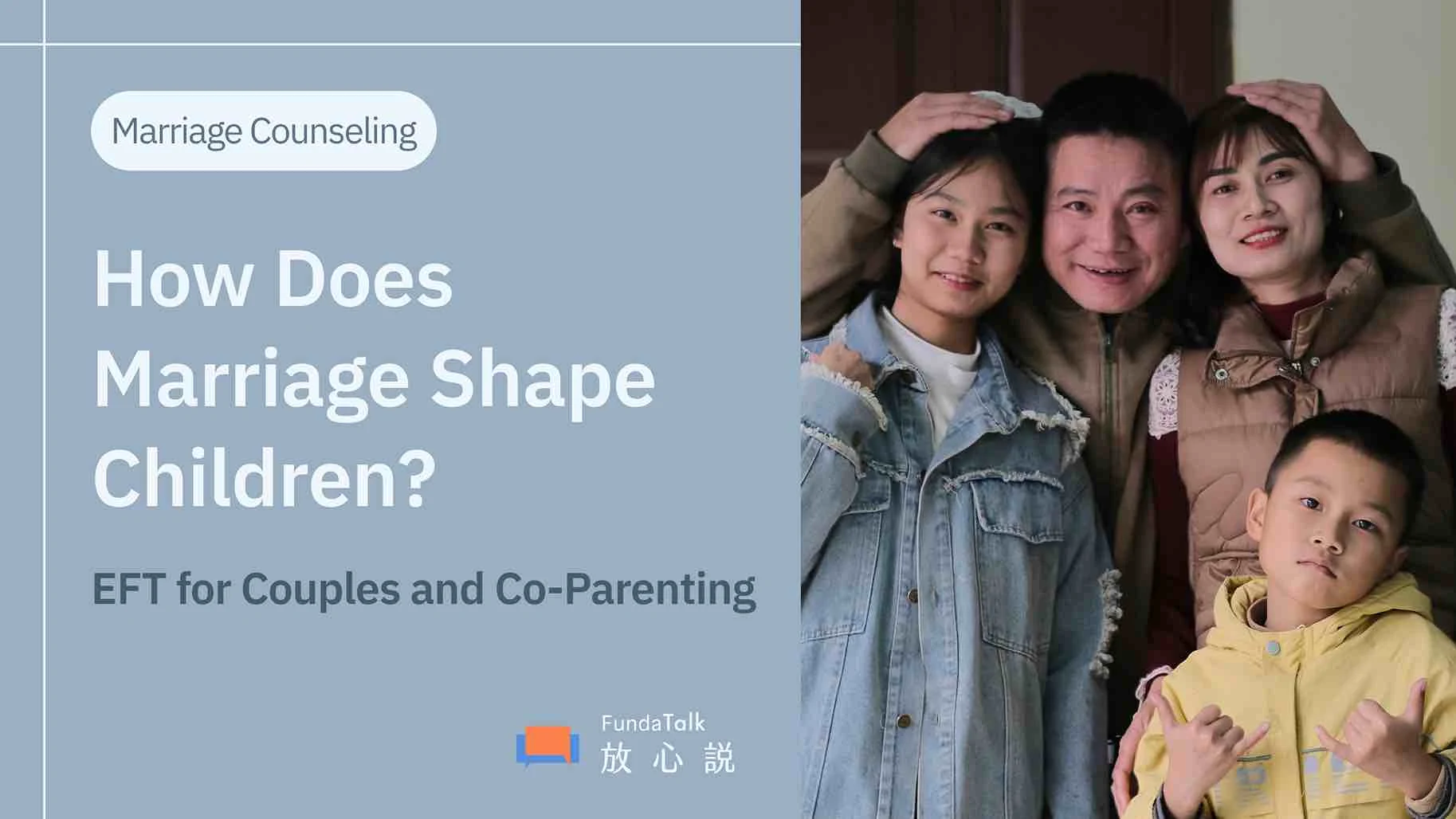
In clinical practice, many parents come in worried about their child's emotional or behavioral difficulties. But when you look deeper, a pattern often emerges: the child's struggles are closely tied to what's happening between the parents.
The family is more than a shared living space. It is an emotional system, and the couple relationship is at the core of that system.

Part 1: Your Couple Relationship Is Your Child's Emotional Climate
Decades of psychological research have consistently shown that the quality of how parents interact with each other directly shapes a child's psychological development.
Studies have found that children who grow up in high-conflict households are more likely to experience:
- Anxiety and depression
- Aggressive or withdrawn behavior
Sleep difficulties and trouble concentrating
But there is another category that often goes unnoticed: the low-conflict but emotionally distant family. When parents are chronically disengaged from each other, children can still develop:
- A diminished sense of security
- Difficulty expressing emotions
- Unstable relationships with peers
In other words, it's not only open conflict that affects children. The absence of connection is its own source of stress.
Part 2: What Is Emotionally Focused Therapy (EFT)?
Emotionally Focused Therapy, or EFT, is a couples therapy model grounded in emotion science and attachment theory.
At its core, EFT recognizes that in intimate relationships, some of our deepest needs are:
- To be understood
- To be responded to
To feel that we matter
When these needs go unmet, couples tend to fall into negative cycles. For example:
- One partner pursues, questions, or criticizes
- The other withdraws or goes silent
What looks like a communication problem on the surface is often two people trying to protect their own hurt.
Part 3: How Does EFT Help Couples?
EFT is not about determining who is right or wrong. It is about helping both partners rebuild a sense of safe connection. The process generally involves three phases.
Seeing the cycle
Learning to understand that the problem lives in the interaction pattern, not in the other person.
Expressing the underlying emotion
Moving from anger and blame toward articulating what's underneath: the loss, the loneliness, the fear.
Building new ways of responding
When one partner can express what they need and the other can meet that moment with openness, the relationship begins to heal.
Part 4: How Does the Couple Relationship Affect Co-Parenting?
When partners are locked in ongoing conflict or emotional distance, it tends to spill into how they parent together:
- Inconsistent standards and expectations for the child
- Lower patience in day-to-day parenting
- Stress that gets carried into parent-child interactions
Children getting pulled into the emotional dynamics between parents
Research shows that marital conflict and parenting stress frequently feed each other, which in turn increases the risk of behavioral problems in children.
Part 5: What Children Are Really Learning
Children observe how their parents relate to each other every single day:
- When there's conflict, do they see attack, cold withdrawal, or repair?
- Are emotions something that can be expressed, or something that must be suppressed?
- Does love feel stable, or does it feel uncertain?
These experiences become the blueprint for a child's future relationships and their foundational sense of security.
Part 6: When the Relationship Heals, Children Benefit Too
Both clinical experience and research consistently show that when the couple relationship improves, children often change alongside it:
- More emotional stability
- Fewer behavioral problems
- A stronger sense of security
Better quality of parent-child interaction
Because the child is now living inside a family environment that is more predictable and more safe.
Author: Dr. Hung-Hsi Wu, MD

Specializes in:
Anxiety disorders, depression, autism/Asperger’s syndrome, attention-deficit/hyperactivity disorder, children and adolescent populations
Further Reading
Feeling Disconnected from Your Partner After Having a Baby? Why It Happens and How to Reconnect
Generalized Anxiety Disorder: Symptoms, Causes, Types, GAD-7 Test, and Treatment Options
Quiet, Withdrawn, and Angry? How Anxiety Presents Differently in Men
Anorexia Nervosa: Early Warning Signs, Causes, Self-Test, Treatment, and Everything You Need to Know
My Child Refuses to Go to School: Causes of School Refusal in Teens and How to Help
Reference
- John Gottman, Katz LF. Effects of marital discord on young children's peer interaction and health. Developmental Psychology. 1989;25(3):373-381.
- Cummings EM, Davies PT. Marital Conflict and Children: An Emotional Security Perspective. New York: Guilford Press; 2010.
- Harold GT, Sellers R. Annual Research Review: Interparental conflict and youth psychopathology. Journal of Child Psychology and Psychiatry. 2018;59(4):374-402.
- Susan M. Johnson. The Practice of Emotionally Focused Couple Therapy: Creating Connection. 3rd ed. New York: Routledge; 2019.
- Wiebe SA, Johnson SM, Burgess Moser M, et al. Two-year follow-up outcomes in emotionally focused couple therapy. Journal of Marital and Family Therapy. 2017;43(2):227-244.
- Erel O, Burman B. Interrelatedness of marital relations and parent-child relations: A meta-analytic review. Psychological Bulletin. 1995;118(1):108-132.
More Articles
 )
) )
) )
)