Do I Have Social Anxiety Disorder? Meaning, Symptoms, Causes, Self-Test & Treatment Options


Don't want to go home for the holidays? Keep making excuses to skip gatherings? Feel a wave of dread every time you need to reply to a message?
If any of this sounds familiar, you may be experiencing social anxiety disorder, and you're not alone.
This article draws on clinical observations from a psychologist to answer the questions people ask most:
- What does social anxiety disorder mean?
- What are the symptoms of social anxiety?
- What causes social anxiety?
- Social anxiety self-test
- Do I need professional help? Where do I start?
- Social anxiety treatment and daily coping strategies

Q1: Do I Have Social Anxiety? What Social Anxiety Disorder Means
Social anxiety disorder, also known as social phobia, is a condition where the brain enters a state of high alert in situations involving interaction, being observed, or the possibility of being judged. This automatic response makes it harder to feel at ease, and easier to feel the urge to escape.
One thing worth clarifying: social anxiety disorder is not the same as introversion. Introversion is about where you get your energy. Social anxiety is about fear. Many people with social anxiety genuinely want connection; it's the process of getting there that feels unsafe and exhausting.
Put simply, social anxiety means a persistent fear of being judged, embarrassed, or negatively evaluated in social situations. It is also called social phobia and is more than shyness when it causes significant distress or leads you to avoid everyday activities, relationships, work, or school.
Q2: What Are the Signs and Symptoms of Social Anxiety?
People with social anxiety disorder don't always avoid people because they dislike them. Often, they want to participate, but an automatic internal response makes it feel costly. Common social anxiety symptoms include:
- Persistent nervousness or dread in social situations, even ones that seem low-stakes.
- Mentally rehearsing worst-case scenarios before an interaction: saying something wrong, being misunderstood, or coming across as strange.
- Wanting to go, but finding reasons not to as the anxiety builds.
Showing up, but feeling physically tense and unable to relax throughout.
Underneath these patterns is usually a fear of being judged or leaving a bad impression.
Something psychologists often notice that people with social anxiety don't always recognize in themselves: they tend to hold their own performance to a high standard while being highly critical of themselves when they fall short.
They remember every awkward pause and wrong word, but rarely give themselves credit for what went well. This uneven internal accounting is one of the reasons anxiety keeps building over time, and it can make social situations feel like evaluations rather than exchanges.
When these patterns start creating barriers in daily life or making it harder to build relationships, they're worth paying attention to [1].
Q3: Why Do People Get Social Anxiety? Common Causes
Social anxiety disorder isn't just about being introverted or disliking crowds.
It has a psychological structure that can be understood and addressed.
Research points to three main contributing factors [2]:
1. Excessive self-monitoring and negative self-image
In social situations, people with social anxiety often direct a large portion of their attention inward: Am I speaking clearly? Do I seem strange? What does that expression mean?
This internal monitoring runs in parallel with the conversation itself, which is exhausting and makes natural interaction harder.
Over time, the habit of scrutinizing every interaction reinforces doubt, and each exchange starts to feel like a performance review.
2. Early experiences of rejection or criticism
If you grew up in an environment where mistakes weren't tolerated, or where you were frequently criticized, ignored, or mocked, your brain learned to associate social exposure with the risk of shame.
Years later, situations that carry even a hint of that dynamic can trigger the same protective response, automatically and without warning.
This isn't about maturity or sensitivity. It's the brain doing what it was trained to do.
3. Heightened sensitivity to social signals
People with social anxiety disorder are often acutely attuned to the expressions, tone, and behavior of others, and tend to interpret ambiguous signals as negative.
Silence reads as disapproval. A delayed reply becomes evidence of rejection.
After an interaction ends, they may spend a long time mentally replaying the conversation, searching for what went wrong.
That replay loop is part of what keeps anxiety from settling.
Q4: Do I Have Social Anxiety? Social Anxiety Test
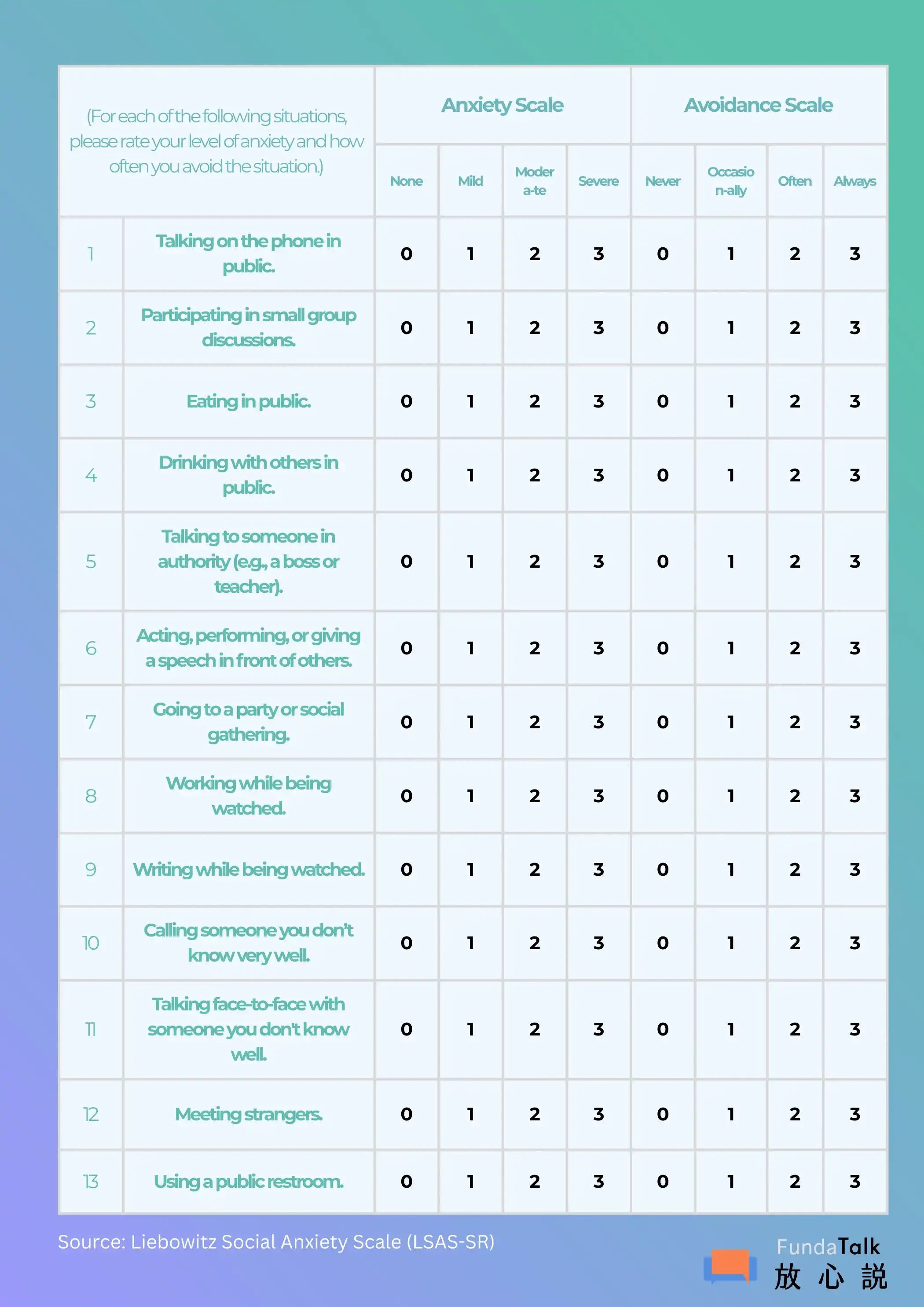
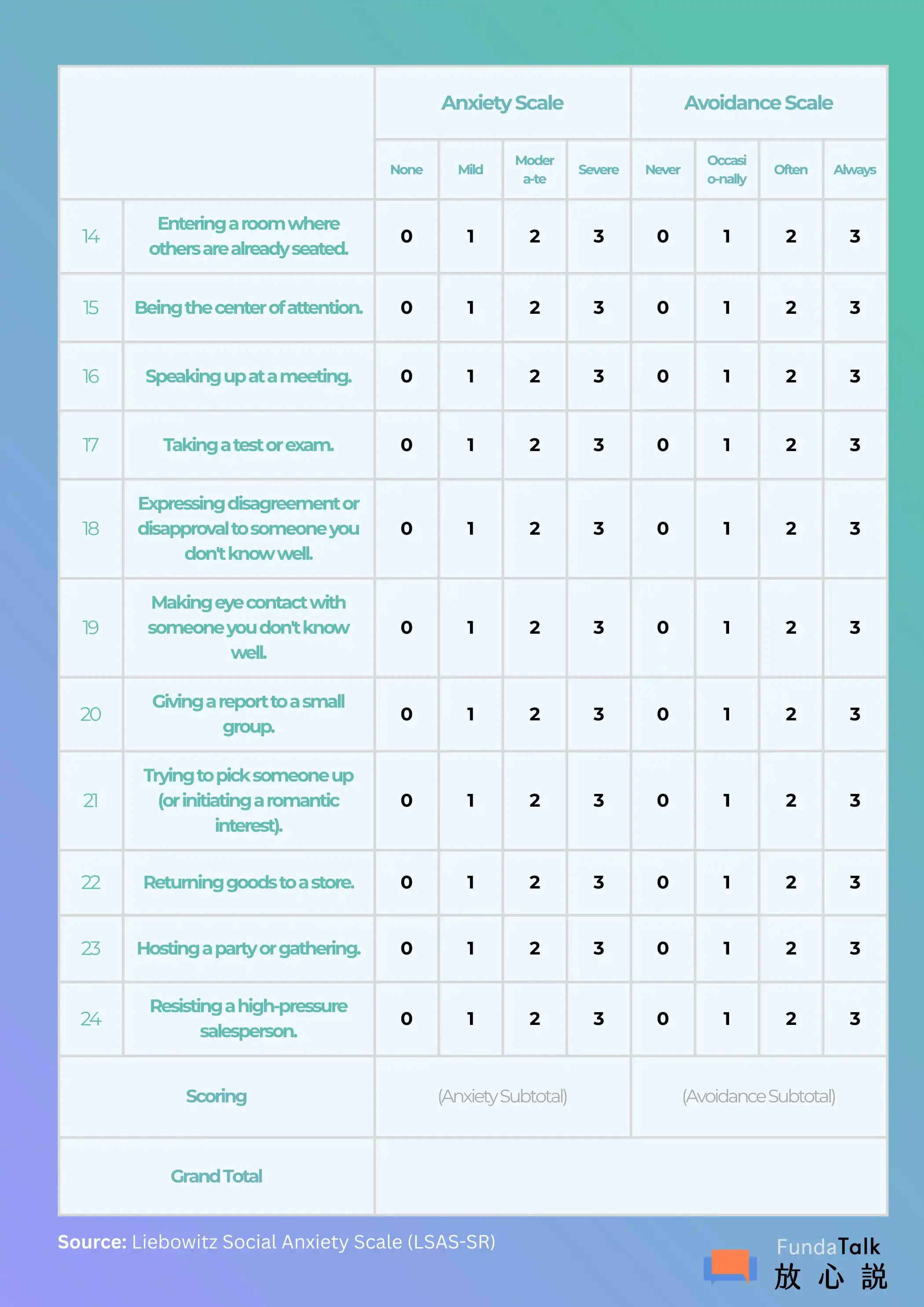
The scale in the attached image helps you understand the degree social anxiety affects daily life, referencing the Liebowitz Social Anxiety Scale (LSAS-SR) [4].
Based on the 24 situations in Figures 1 and 2, separately answer: 1. Your anxiety and fear level (0-3 points)? 2. How often do you avoid this situation? (0-3 points)
Calculate Results:
Add up scores for all questions to see which range the total falls in:
31-50 points: Mild social anxiety
51-70 points: Moderate social anxiety
71+ points: Significant social anxiety
Note: This scale is for reference only. Formal diagnosis still requires evaluation by professional psychologists or Psychiatrists.
Q5: When Does Social Anxiety Disorder Need Professional Help?
Feeling nervous in unfamiliar or high-pressure situations is a normal human experience. But if you notice any of the following, it may be worth speaking with a professional [3]:
- Consistently avoiding social situations, with your world gradually getting smaller.
- Physical symptoms in social settings: rapid heartbeat, shaking, nausea, or blushing that feels out of proportion to the situation.
- Relying on alcohol or other substances to get through social situations.
- Signs of depression, or a growing pattern of withdrawing from people altogether.
If these reactions already affect daily life and have persisted for some time, it means stress has accumulated to a level requiring professional help. It's recommended to speak with a mental health Psychiatrist and have them help evaluate.
👉 Are you experiencing similar feelings? Talk to a Psychiatrist about your situation
Q6: Can Social Anxiety Improve? Treatment and Daily Coping Strategies
Social anxiety disorder is treatable.
Beyond professional treatment, there are also things you can practice in daily life that can gradually shift how social situations feel.
- Redirect attention outward. Instead of monitoring yourself, try focusing on the other person. Ask questions. Get curious about them. This not only helps you feel more present, it makes conversations flow more naturally.
- Prepare lightly. Having a few topics in mind before a social event can reduce the anxiety of silence. If it helps, practice with someone you trust, or with a psychologist, to get familiar with the rhythms of interaction before higher-stakes situations.
- Unhook from the idea of performing perfectly. Nervousness is normal and visible far less than it feels. Try noticing your physical sensations without judgment, or use a simple breathing practice to help your nervous system settle.
- Give yourself permission to step back. If a situation becomes overwhelming, finding a quieter corner or briefly stepping outside is not failure. It's good self-management, and there's no need for self-criticism.
Recovery from social anxiety disorder isn't about forcing yourself into discomfort until it stops. It's about slowly building trust in yourself.
Each time you stay a little longer than you did before, that counts.
👉 Finding experts to help me understand social anxiety causes
Conclusion
There's no single right way to be social. Some people are energized by crowds; others aren't, and that's fine.
If social anxiety disorder isn't significantly affecting your life right now, you don't need to rush anything. Start with situations that feel manageable and build from there. The goal isn't to become someone different. It's to give yourself more room to move.
Noticing these patterns in yourself, and wanting to understand them better, is already a meaningful step.
Author: Chen Jou-An, Psychologist

Extended Reading
- Middle and High School Student Doesn't Want to Go to School—What to Do? School Refusal Causes and Support Approaches at a Glance
- What Is Generalized Anxiety Disorder? Complete Analysis of Causes, Symptoms, Medication and Non-Medication Treatments, and Relaxation Methods
- Recommended Online Psychological Counseling Platform: Fundatalk's Pricing, Process, Preparation Items, and Free Resources at a Glance
References
- Alomari, N. A., Bedaiwi, S. K., Ghasib, A. M., Kabbarah, A. J., Alnefaie, S. A., Hariri, N., Altammar, M. A., Fadhel, A. M., & Altowairqi, F. M. (2022). Social anxiety disorder: Associated conditions and therapeutic approaches. Cureus, 14(12), e32687. https://doi.org/10.7759/cureus.32687
- Clark, D. M., & Wells, A. (1995). A cognitive model of social phobia. In R. G. Heimberg, M. R. Liebowitz, D. A. Hope, & F. R. Schneier (Eds.), Social phobia: Diagnosis, assessment, and treatment (pp. 69-93). Guilford Press
- National Institute for Health and Care Excellence. (2013). Social anxiety disorder: Recognition, assessment and treatment (Clinical guideline CG159). Retrieved from https://www.nice.org.uk/guidance/cg159
- Liebowitz, M. R. (1987). Social phobia. Modern Problems in Pharmacopsychiatry, 22, 141–173.
More Articles
 )
) )
) )
)