Alexithymia: 4 Common Signs, Causes, and What Can Help


People with alexithymia may be able to tell you exactly what happened and still find it hard to identify, understand, or describe how they felt.
In clinical settings, alexithymia describes this pattern of processing emotions.
Maybe you’ve had moments when you couldn’t find words for how you felt. Or maybe you’re trying to understand a partner or family member who has trouble talking about feelings and often says, “I don’t know what to say.”
This article may help you make sense of those moments.
In this article, we’ll cover:
- What is alexithymia?
- What are the signs of alexithymia?
- What causes alexithymia?
- How common is alexithymia, and who is more likely to experience it?
- How is alexithymia assessed?
- Can alexithymia affect relationships?
- What can help with alexithymia?
- How can you support someone with alexithymia?

What is alexithymia?
Feeling an emotion, noticing it, figuring out what it is, and expressing it are all part of a complex process.
People with alexithymia experience emotions, too.They often have trouble sensing what they feel, identifying it, or describing it.
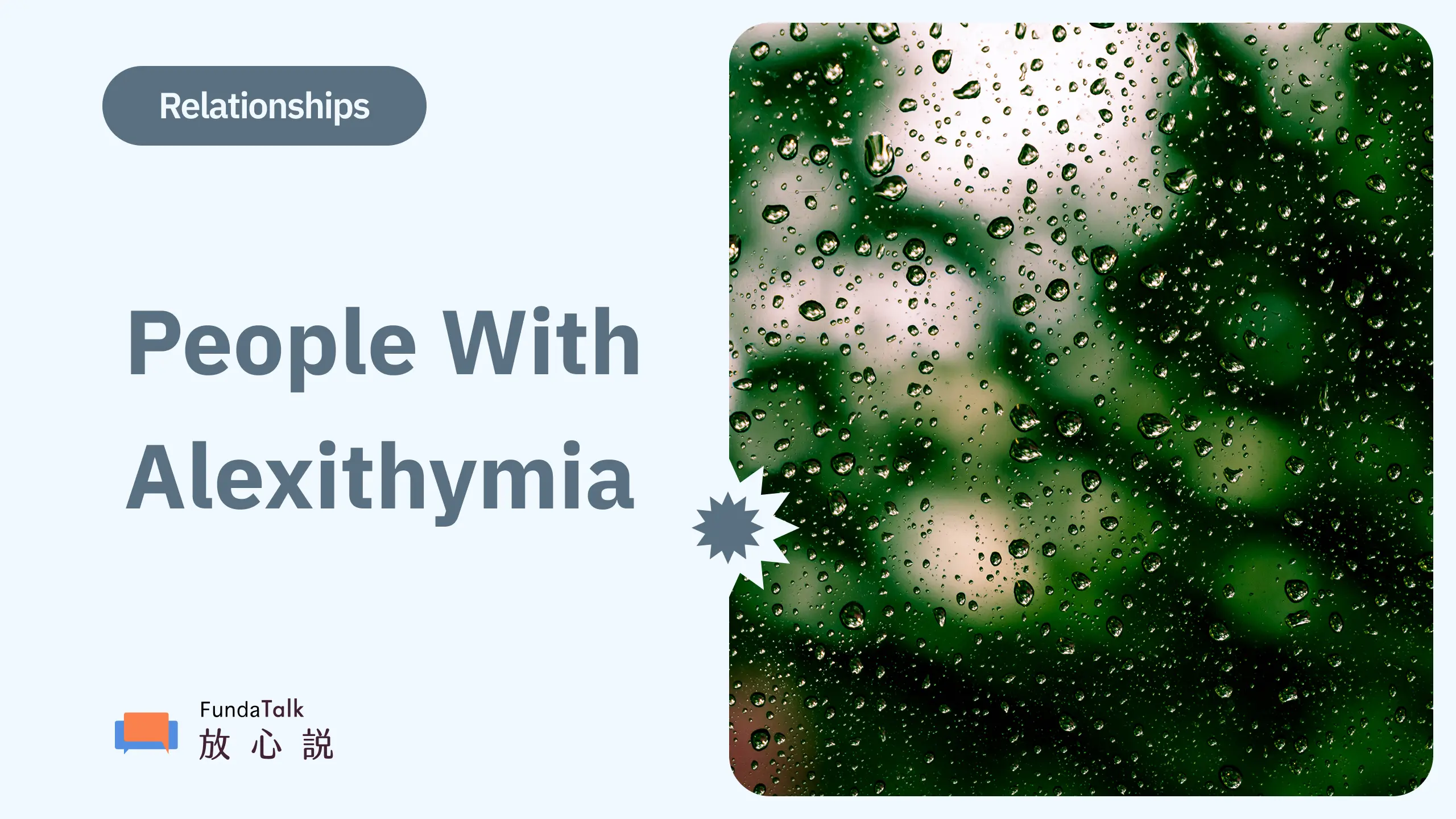
It’s a little like looking at your feelings through a blurry lens.You can tell something is there, but it’s hard to make out what it is.
Alexithymia is generally understood as a trait related to how we process emotions.
It isn’t a formal medical diagnosis, and people can experience it to varying degrees [1].
What are the signs of alexithymia?
For people with alexithymia, an emotion can be there long before they notice it or find the words to describe it.
Here are four common ways this can show up [2]:
- Difficulty identifying feelings. Other people might notice that you seem down or irritable before you realize it yourself. Even when you sense something is wrong, you may struggle to name it.
- Difficulty describing feelings. When you try to explain how you feel, all you can come up with might be “I’m frustrated,” “Something feels off,” or “I don’t know what to say.”
- Externally oriented thinking. You tend to focus on what happened and how to handle it, with less attention to what you’re feeling inside.
- Difficulty linking physical sensations to emotions. When your heart races or your stomach feels upset, you might assume you’re tired or that something is physically wrong without noticing a possible connection to how you feel.
In therapy, a therapist might ask, “What were you feeling in that moment?”
For someone with alexithymia, that simple-sounding question can take a long time to answer.
They may go quiet while trying to find the right words.
What causes alexithymia?
Alexithymia may be related to inborn traits, early experiences, psychological trauma, or brain function.
One way to understand how it develops is to look at three possible pathways [1].
Developing in childhood.
Recognizing and expressing emotions are skills we can build over time.
Children who get little guidance or are often told “Don’t cry” or “Don’t get angry” may learn to tune out their feelings and have fewer chances to practice expressing them.
Emerging later in life.
Difficulty identifying emotions can also develop after a traumatic or acutely stressful event, or during a prolonged period of depression or anxiety.
Imagine someone going through an upsetting experience.
They might feel scared, angry, and hurt all at once.
When those feelings are overwhelming, they may start to tune them out without realizing it and gradually feel numb.Tuning out those feelings may bring some relief in the moment.
Over time, though, it can get harder to identify emotions or tell what’s making you tense or irritable.Temporarily tuning out painful feelings can be a natural response to stress.
Repeatedly avoiding them over time can make them harder to understand and work through [1].
Following a brain injury.
Recognizing and processing emotions involves several areas of the brain and the networks that connect them.
A stroke or traumatic brain injury can affect how a person processes emotions and make feelings harder to identify or describe.
How common is alexithymia, and who is more likely to experience it?
About 10% of people show traits of alexithymia [2].
It can also occur alongside conditions such as eating disorders, depression, and schizophrenia [1].
Alexithymia is more common among autistic people. In one review, about half of the participants with autism spectrum disorder (ASD) met the cutoff for alexithymia on a rating scale [3].
Autism and alexithymia are distinct. A person can experience either on its own, or both together.
Can alexithymia affect relationships?
Talking about feelings comes up naturally with partners, family, and friends.
When one person can’t explain what’s going on and the other is left guessing how to respond, misunderstandings can build quickly.
This can make emotional closeness and everyday communication more difficult for people with alexithymia.
A 2022 study found that higher levels of alexithymia were associated with lower relationship satisfaction [4].
What can help with alexithymia?
If you have trouble naming what you feel, these four everyday exercises can help you start noticing and identifying your emotions.
Start with what you notice in your body.
Emotions can come with physical changes, such as a racing heart, tightness in your chest, tense shoulders, or diarrhea.
If you can’t find words for the feeling yet, try describing the sensation.
“My heart was racing in that meeting.”
“My neck tightened up when I read that message.”Then ask yourself what those sensations might be telling you.
What feelings might go with them?
Name a few possible feelings.
Think back to what you noticed in your body. Could you have been nervous, anxious, or embarrassed? You might find one feeling that fits, or several at once.
Look for clues in what you do.
Sometimes you notice what you did before you know how you felt.
If you keep checking a message, you might be worried you made a mistake.
If you suddenly don’t feel like replying to someone, you might be angry, disappointed, or tired.
Notice what changed before and after an event.
Maybe you felt calm before a phone call and restless afterward.
Think back to a comment or moment in the call that might have shifted how you felt.
How can you support someone with alexithymia?
It can be frustrating when someone close to you, especially a partner, struggles to express their feelings.
You may wonder what’s on their mind or how to respond.
Along with trying to understand what it’s like for them, here are three ways you can adjust how you relate to each other.
Get to know how each of you shows love.
Some people have trouble talking about their feelings but show they care by being there consistently, taking on their share of chores without being asked, or remembering the little things that matter to you.
Look for those everyday signs of care and let your partner know what helps you feel loved.
Give them time to sort through their feelings.
When your partner says, “I don’t know,” they may genuinely need more time to work out what they’re feeling.
Try offering a choice.
“Would you like to take a break, or do you want to keep talking?” A little space can make it easier to talk.
Let them see things from your perspective.
People notice different things, and we often make sense of others through our own experiences. Your partner may miss the hurt, hopes, or disappointment you’re finding hard to put into words.
Try telling them what you’re feeling and what you need.
That gives them a chance to understand what the situation has been like for you.
A note from the therapist
Learning to notice and express your feelings takes practice and some trial and error. It’s okay if you can’t find the right words at first.
Start by asking yourself, “What’s going on with me right now?”
Simply noticing how an event might connect to a feeling is a good place to start.
Further reading
- How to Build Self-Awareness: 4 Ways to Get Out of Your Head and Feel Less Anxious
- What Does Asperger’s Look Like in Women and Girls?
- How Partners Can Support Each Other as Parents: Emotionally Focused Couples Therapy and Co-Parenting
- Why Don’t I Enjoy Anything Anymore? A Psychiatrist Explains Anhedonia
References
[1] Messina, A., Beadle, J. N., & Paradiso, S. (2014). Towards a classification of alexithymia: Primary, secondary and organic. Journal of Psychopathology, 20, 38–49. https://old.jpsychopathol.it/wp-content/uploads/2015/07/08-Messina1.pdf
[2] Goerlich, K. S. (2018). The multifaceted nature of alexithymia – A neuroscientific perspective. Frontiers in Psychology, 9, 1614. https://doi.org/10.3389/fpsyg.2018.01614
[3] Kinnaird, E., Stewart, C., & Tchanturia, K. (2019). Investigating alexithymia in autism: A systematic review and meta-analysis. European Psychiatry, 55, 80–89. https://doi.org/10.1016/j.eurpsy.2018.09.004
[4] Lyvers, M., Pickett, L., Needham, K., & Thorberg, F. A. (2022). Alexithymia, fear of intimacy, and relationship satisfaction. Journal of Family Issues, 43(4), 1068–1089. https://doi.org/10.1177/0192513X211010206
[5] Tsubaki, K., & Shimizu, E. (2024). Psychological treatments for alexithymia: A systematic review. Behavioral Sciences, 14(12), 1173. https://doi.org/10.3390/bs14121173
[6] Ditzer, J., Wong, E. Y., Modi, R. N., Behnke, M., Gross, J. J., & Talmon, A. (2023). Child maltreatment and alexithymia: A meta-analytic review. Psychological Bulletin, 149(5–6), 311–329. https://doi.org/10.1037/bul0000391
A 2023 study found that childhood experiences such as emotional neglect were associated with greater difficulty identifying and describing emotions in adulthood.
More Articles
 )
 )
 )